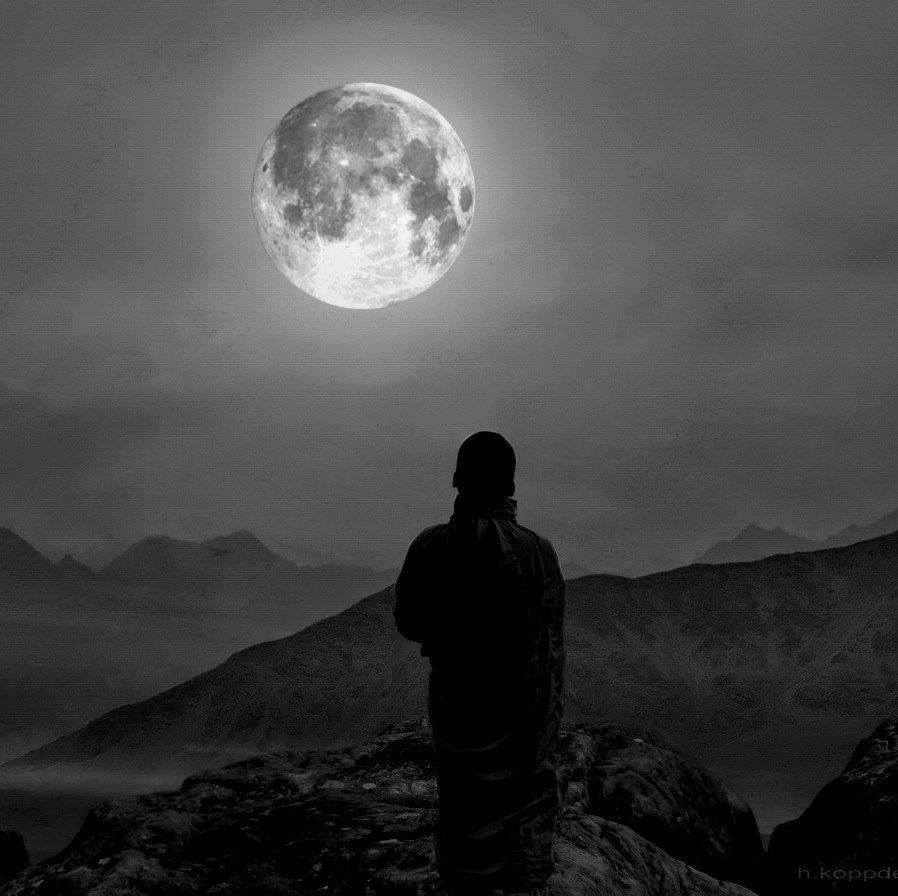
My Mind Relief From Madness

About a month ago my mind and vital was in the grip of something. I don’t remember what now exactly, but it was something that had been troubling the  mind and holding it under siege for a couple of days. I wanted to get free of the movement but was having trouble doing so. Then I received these lines from the muse in the morning:

Don’t muddy the mind courts (Came at the end of a dream where I was watching a performance of the hip hop group Run DMC)
My mind relief from madness
Mooning.

The first line’s advice was pretty clear, and motivated me to really try and throw the disturbing thoughts out of my mind, but I was having only limited success. Then all of the sudden, in the evening, I noticed my mind got abnormally clear, and it didn’t take much effort to keep it clear. There was no peace or joy or anything, just a quiet, fairly focused mind. Still it was a welcome respite.

Sri Aurobindo says, among other things, that the moon is a symbol of the spiritual consciousness which is above our normal human mind. One of the main movements in the integral yoga is for the sadhak to not only ascend to this level (or levels I should say) of consciousness, but also for it to descend and transform these lower levels of mind, life and body as well with its peace, silence, light and bliss. So what happened here I think is I got ‘mooned’ by a descent from the spiritual consciousness which quieted my mind and gave me relief from the mind’s madness. It didn’t last and was gone the next morning, but it broke the momentum of the disturbing thoughts, and I was able to move past them. I imagine it was important that, prompted by the muse, I was making a strong effort to throw out the thoughts myself. That I feel opened the door to the descent from the spiritual consciousness.

Now as the reader has no doubt noticed, the first line came at the end of a dream. This is a fairly common occurrence, but I have to admit I often can’t make any connection between the lines that come at the end of a dream and the dream itself. A lot of the time the lines don’t seem to have anything to do with the dream.  Here though I can see a correlation between mud in the mind and hip hop music, which overall has a pretty low vibration, one that appeals to the less enlightened parts of the human vital.

Does anybody else see anything in these lines that they want to share in the comments?

I Want Struggles To Be Light

A few days ago this line from the muse came to me in the morning.

I want struggles to be light.

You can definitely play around with multiple interpretations of a line like this because of the different meanings for the word ‘light’. One interpretation jumps out right away if you take ‘light’ in the sense of something being not heavy or not dark in color. Read this way the line is saying that I want a lighter load of struggles.  There’s no doubt I feel that way often, and I’m sure most people reading this can relate to that sentiment. Another idea though along these lines has to do with my belief that what really makes struggles and pain so dark and heavy is this consciousness we live in which is a state of identification with this mind and body. But as many spiritual teachers have said throughout the ages, if you can enter into a consciousness where you’re identified with the divine, or oneness or whatever you want to call it then you realize that this mind and body isn’t you, is more like a shirt you’ve put on, and you don’t take what happens to them so seriously anymore. Then, even though life’s challenges are still there, they’ve lost their heaviness, and you no longer suffer from them. You deal with them from a state of Light or Knowledge and not a state of Ignorance.  Hand in hand with that idea is a complementary take on the line where ‘light’ means spiritual illumination. This gives the sense to me of struggles being spiritually illumined and transmuted.

Another interpretation that occurred to me takes ‘light’ in the sense of a ‘means of igniting something’ as in “Hey buddy, you got a light?”. It’s a less obvious reading of the line and one that probably wouldn’t have occurred to me if I hadn’t been thinking a lot about something I’d read in the Mother’s Questions and Answers a few days before. I’ll share the quote first before I get into the interpretation.

Quite naturally we ask ourselves what this secret is, towards which pain leads us. For a superficial and imperfect understanding, one could believe that it is pain which the soul is seeking. Nothing of the kind. The very nature of the soul is divine Delight, constant, unvarying, unconditioned, ecstatic; but it is true that if one can face suffering with courage, endurance, an unshakable faith in the divine Grace, if one can, instead of shunning suffering when it comes, enter into it with this will, this aspiration to go through it and find the luminous truth, the unvarying delight which is at the core of all things, the door of pain is often more direct, more immediate than that of satisfaction or contentment.1

So like the Mother says here I think the line could be interpreted in the sense of changing my attitude so that struggles and pain become more a means of advancing on the spiritual path, more a means of igniting my aspiration to go through them in order to reach that ‘unvarying delight’ than something that holds me back when I have  resistance to the pain or depression about the pain. Backing up this idea, I feel, is an experience I had with Medhanada’s Eternity Game two nights before I received this line and a few hours after I’d read the above quote from the Mother. That quote is part of a longer passage where she says a number of things one of which is “When pain comes, it comes to teach us something.”2 As I’ve mentioned in other blog posts, probably my biggest difficulty is contending with the constant chronic pain in my back and knees. So that night after reading the Mother’s words I asked the Eternity Game, “What’s the purpose of this pain?” The card I drew was ‘Dwarf’.

Europe 1997.3 25

In the Eternity Game this card represents the mental being, and as you can see its aspects are ‘Quest’, ‘Next Step’ and ‘Intelligence’. Medhananda gives detailed commentary on all the cards in the game, but he also gives short one sentence descriptions.  The short one he gives for the ‘Dwarf’ card is ‘advance, take the next step.’3 I took this as confirmation that I have to try and take the mental attitude the Mother recommends towards the pain so it becomes more a means of progress. I should point out that for me the fact that my reading of the  Mother’s words was followed by synchronicities with both the Eternity Game and my own inner guidance in just a matter of a few days stresses the need for this change in attitude. It’s not easy to do, and to truly surrender this pain is something I’ve been aspiring for for a while. Hopefully this will help me to take the ‘next step’ with that.

So that’s my take on things. Please feel free to share other ideas in the comments!

References

  1. Questions and Answers 1957-1958  by the Mother pg 41
  2. Ibid pg 42
  3. The Eternity Game by Medhananda pg 133


The Strength is on the Distant

This line of guidance from the inner voice came to me some months back:

The strength is on the distant

The first interpretation that jumped out at me was the yogic technique of distancing yourself from undesirable lower movements, looking at them as not oneself and detaching rather than struggling with them. Looking at the line that way helped me to free myself from the weakened but lingering siege of a strong vital reaction that had gotten in the day before the line came.  Do any other interpretations jump out at anyone?

Snowshard that Ape

Recently I was going through my files on my computer and I came across an aborted dream/inner journal from four years ago that I’d forgotten about. It only had a few entries and one of them was this line from the inner voice:

Snowshard that ape

Below the line I had written some comments stating that I thought the line had to do with sexually staring and fantasizing, that this was the ape-like behavior I was exhibiting, and that I needed to stop it. That may very well be true since that was a big problem I was struggling with back then. As Donny pointed out to me however, the ape is more of a general symbol for the animal vital in us and symbols like the dog, pig or goat more commonly represent sex itself specifically. Given this the ape could symbolize any primitive movement such as anger, jealousy, selfishness etc. and not just sex. With this idea in mind of a wide range of movements potentially symbolized by the ape, let’s further analyze the line’s meaning by looking at the words snow and shard.

As far as snow goes, the first thing that word suggests to me is purity, but there’s also the sense of cold or freezing. This gives the idea of stopping the ape-like behavior ‘cold’ and purifying myself of it. The word shard suggests something sharp and dangerous that can cause harm, so here we have the idea of ‘killing’ the ape-like behavior. In addition though I would also point out that when something is shattered it breaks up into shards, and like humpty dumpty can’t be put back together again. From this we can get the idea of ‘shattering’ the movement, weakening it to the extent that it can’t reconstitute itself and become a significant problem again.

So I guess I could sum up the line’s meaning as “Stop that ape in it tracks and shatter that impure movement.” Now one thing I really like about this line is its bluntness, the way it calls a spade a spade. It really helps me see how I’m acting like an ape, so I’ve been making use of the line since rediscovering it. I’ve mainly been using it to remind myself to snowshard the sex movement, but I also used it this morning when some annoyance reared its head. If you’re reading this and think it could help to snowshard the ape in you please feel free to use it.

Dream Drugs

peyote flower by zapdelight, on Flickr
Creative Commons Creative Commons Attribution-Noncommercial-No Derivative Works 2.0 Generic License   by  zapdelight 

I would imagine many people have had the experience of taking a drug like marijuana or alcohol in a dream and feeling high or intoxicated while within the dream, but having the effect disappear upon awakening. This has happened to me a number of times over the years. What’s perhaps less common, but in my experience possible, is to take a drug in a dream or vision and have it produce an effect in the waking consciousness. I’m going to share two examples of this. In one instance, the effect was immediate, and in the other there was a slight delay.

The first example I’ll give occurred about 16 years ago in Mexico in the part of the country where peyote grows wild. I was out there with a group of people including Dominique, a French Canadian woman and peyote connoisseur. On that day I had not eaten any peyote. It was about mid-afternoon, and I was having a sinking spell so I laid down to rest. I didn’t fall asleep but entered that twilight space between waking and sleeping and had this vision:

I was with a group of people gathered around a fire. A deep, and powerful voice kept repeating the word “Amor” (which means love in Spanish) and I could actually feel the sound waves from the voice penetrating my dream body. Then Dominique put a piece of peyote on my tongue. As soon as the piece touched my tongue, it sent a jolt through my entire body and I was abruptly brought back to full waking consciousness.

At first nothing interesting happened, and I just got up and started to resume waking activities. After a few minutes though, I suddenly found myself filled with a large upwelling of love wanting to find some means of expression. Fellow Harm’s End editor Donny was there in the desert with me and my first instinct was to go and find him. On my end I was irked with Donny about some things, and the love helped to see that those feelings really weren’t legitimate. When I found him I told him that, and was able to clear the air as well as my vital. After that the love began to fade and then was gone. All in all I would guess that the experience lasted about 30 minutes.

Roughly a year later I had another memorable experience with a dream substance. This time I was in Nicaragua and was once again with Donny. We were staying in a hotel near the border with Costa Rica and had plans to cross the following morning. At around 4 am, I awoke from a dream in which I had been drinking coffee. Since it was still dark outside I tried to go back to sleep but found it impossible to do so because I was COMPLETELY awake. Normally I feel quite horrible if I try to get up early in the morning, but this time there was no grogginess whatsoever and my body felt energized and ready to go. As I lay there I sensed that Donny was also awake, so I told him about the dream and what I was experiencing. We concluded that there must be some purpose behind it, and that the most likely reason was to give us an early start. So we got up and went to the border only to sit there and wait for three hours for immigration to open at 9 o’clock. Go figure. Despite that however, Donny and I remained convinced that forces had moved us out of there at an early hour for a reason even if we couldn’t see it.

Unlike other posts of mine there’s no real concluding lesson or moral to my sharing of these experiences. I’ve really just thrown this out to show what’s possible and maybe spark the interest of a reader or two towards their inner life. If this possibility perks your interest then why not try for yourself? Put your intention in that direction before sleeping and see what happens. Give it a fair shake if you don’t have immediate success. I do recommend though that you approach this exercise and dreams in general with the intention to learn or to grow. While dreams can serve as entertainment for the human vital, especially if you’re a skilled lucid dreamer (I myself am not), that isn’t in my opinion their true purpose. Rather I feel dreams are an aid for our growth and development and should be approached as such.

Every woman’s shape is your mouth.

Image source: http://www.womensbeautylife.com/

Recently I received this line from the inner voice:

Every woman’s shape is your mouth.

On one level I think this line was drawing attention to the way I let myself get sucked into chit-chat at work, and how I can be critical in a negative or gossiping way.   Whether it’s ultimately true or not, we have a cultural conception that women gossip more than men. Looking at the line through that cultural lens the ‘woman’s shape’ of my mouth struck me as that gossiping element.

When I told Donny about the line he validated that interpretation, and also suggested it had something to do with desire. A few days later that interpretation hit home when my parents and I went out to eat at one of our favorite restaurants, Citrola’s. We eat at this restaurant enough that we’re recognized by the staff and even have a favorite waitress, Lynn. Lynn I would guess is in her late 50’s or early 60’s, but has a body that looks younger. She’s very slim and petite and of course colors her hair. She also has an attractive face though there are enough wrinkles there to tell you she’s no spring chicken. I’m sure many men of all ages find her attractive. I’m no exception.

That night at Citrola’s Lynn was not our waitress, but since she knows us, at one point she sat down next to me at our booth to chat. As she sat there I was feeling the color of attraction and to be honest was indulging it some. Sitting there though I thought about the line and realized what it was saying. It was pointing out how wide my range of attraction is. How ‘every woman’s shape’ stimulates my ‘mouth’ i.e. the desire to consume the object of the attraction. Now of course I’m not attracted to every woman I see, and I certainly wasn’t ignorant that I could be attracted to a woman old enough to be my mother, but lines from the inner voice, like dreams, are exaggerated to make a point. Here what the line was also pointing out and really driving home is something I’ve seen many, many times before, but apparently had to be shown again. Namely what a brainless, primitive thing the desire is.

Now for those who might be wondering why anyone would want to give up sex or sexual desire here’s a line I got about two and half years ago about sex.

Immense Adam block.

 Adam here I feel represents the soul or Purusha since, on one level, that’s what Adam represents in the Hebrew Genesis. The line clearly points out I’m blocking my soul by indulging in the sex feelings and movements. In fact, it spelled it out so clearly that this particular line was a real turning point for me. After that I really started working at trying to not follow the sexual movements. Over two and half years later they’re still not gone, but Sri Aurobindo points out how hard it is to completely get rid of those movements and even said to one person that only the descent of a higher consciousness will completely get rid of them. My continuing job at the moment though is to not follow them or clip them off as soon as I catch myself doing so. I’ve come a long way with this from where I was when I got the ‘Adam’ line, but this latest line provided motivation to step up my game. That was at least a big part of its purpose.

If you’re still scratching your head as to why someone would want to give up sex you can read more of what Sri Aurobindo says about it here.

And I Suppose a Rose

Full Moon Meditation by H. Kopp-Delaney (CC BY-ND 2.0)Full Moon Meditation by H. Kopp-Delaney (CC BY-ND 2.0)

As a young teen, I would often hear, right at the stage of falling asleep, what I called ‘reading the book’, someone speaking spiritual philosophy deep inside my head. I never could remember a word the next morning.

After getting a rather poetic education, majoring in English and learning to translate Classical Greek verse into English verse, and a period of travel after college, mostly as a vagabond, in one instance posting my poems on holy sites in the old city of Jerusalem and other places East, a woman who had a writer’s cabin in the hills around Ashland, Oregon gave me the cabin for a whole winter, 5 months, so I’d have a place to live because I was homeless (normally it was a 6 week stay, given as a fellowship).

After 3 months of relative isolation, snowed in some, in twilight, that place of falling asleep, only here I think it was waking up, I heard these lines:

And I suppose a rose knows well
All the glory a man might.

I took those beginning lines and made a poem out of them, thinking that’s what many poets do and just don’t say anything. I had no idea your muse, what I call it, not hearing things, could give you a whole poem and edit it while you’re ‘listening’ it and after. It took another few years before I heard more lines, which was in Cuzco, Peru, about 15 years ago, but the flood started in Brazil a few months later, and it’s continued to this day.

There’ll come a day when floods.

Almost anytime I sit or lie back inside myself, if it’s long enough to get behind the waking mind and into ‘twilight’, I just automatically start hearing and seeing muse, and only sometimes it’s a poem; most of the time it’s a host of things: personal guidance, remote viewing, subconscious stuff, the imitation vision, the outright hostile vision, and I can continue some, only with me whatever I hear is always in poetic form, though only rarely is that at or near poetic quality.

Another time I might show the visual aspect of the muse. Now I’ll end this post introducing my voices with a recent short poem completely from the muse (it’s on one of our blogs at: The Chipmunk Press Vol. 3 Issue 5

Original Sin

In a sunny corner of remote earth
The bite of it all
Challenged orthodoxy.
This was in Nature’s plan.
Green-gold it moved.
This conducted harmony
Operating on discords –
Not a packaged plan,
Neither from the stars.
It brought in cities beyond the universe.
We bask in its revelry –
A riot of God
On lone isles of trust.
Wonderful it wore shoes.
Naked impulse did not light its lamp.
A renegade
It brought all to bear on noontide.
Light held its room.
“Yes,” we sing in darkness’ lair.
“We deliver anthems
Without knowing on which we rest.
It came to us unclothed,
And we saw nought but sin.”
What distance orthodoxy
From all that abounds in this place.

Lucid Quest for the Light, a video

I saw this on a Lucid Dreaming closed group page I follow, and over 12,000 people are in it, and so it’s a fast feed. Coming at me are ideas, images, and videos that run the gambit if something’s worth my time or not, and so I have to be very choosy or I waste my time, which I have to add isn’t so bad because it’s good to see all the degrees of quality, from bad to worse. While there is a lot of ‘good stuff’, and things I just need to see, else I wouldn’t follow the group, much of the material and media coming down the page is either ads (disguised as a person; I do it too) or rough drafts to say it kindly.

A difficulty in detecting things of quality is that things are coming down the pike very quickly, and you only have a second or so to recognize quality work, and that kind of work by its very nature takes more than a second or two to appraise. In fact a lot of the time it’s even jarring and disjointed, or too obtuse, the first couple of three times you see it.

You have to give it more than a chance, and so, it’s not possible to always or even often actually spend you time on what’s worth your time, since something worth it also taxes you at the same time, taxes you with your focused attention, and you don’t give that freely. It’s the dilemma of art in a digital medium, a dilemma of us all.

This video by Paul W. Coca is art, maybe not Michael Angelo or immortal, but it crosses that indefinable line that makes a work art. I didn’t see it the first time, only saw a good video, but after living with it some, and especially after Douglas liked it (I admit it I’m herd sour), I see what I’d like to share with others because it will enrich them.

Donny

A Review of ‘Joan of Arc: A History’

Edward Reginald Frampton (British, 1872 by sofi01, on Flickr
Creative Commons Creative Commons Attribution-Noncommercial 2.0 Generic License   by  sofi01 

This new biography of Joan of Arc by author Helen Castor recently caught my eye on the new release rack at my local library.   At the time, I honestly knew precious little about Joan of Arc other than she fought against the English, was burned at the stake and heard what she claimed were divine voices, so I was curious to know more about this historical spiritual figure and checked out the book.

I don’t know how other biographies of Joan have handled things, but this one rightly takes its time in setting the scene, starting with the British invasion and then navigating all the different twists and turns of the war until Joan arrives on the stage fifteen years and eighty-six pages later.   In doing so, the book really gave me a stimulating glimpse into the mind of the times I previously didn’t have. The middle ages weren’t something I knew a whole lot about either other than what stuck with me from high school history i.e. there were kings and knights, the pope and the Inquisition, the bubonic plague, a lot of wars, and your average person was basically miserable and oppressed.   The book shows a lot about what a powerful force religion was back then. It’s not really clear from the book how your basic peasant looked at things, but the nobles and the clergy looked for evidence of God’s favor or disfavor or even whose side God was on in events like the outcome of battles. And if you lost a battle in a particularly ugly manner, like the French did at Agincourt, the clergy would debate amongst themselves as to which sin it was and committed by whom that brought the misfortune upon them. They also used signs and portents to determine what actions to take and when to take them. It was also not uncommon for people to claim to hear divine voices, and thus the means of discerning who was hearing the divine and who was hearing the demonic was a topic of no little import amongst the clergy of the time.

With the groundwork patiently and properly laid by the author, our firebrand Joan then enters the picture as the strategic river city of Orleans is under siege by the English. We quickly see that Joan is remarkable for more than just hearing voices. The book makes very apparent the incredible force of personality of this simple God-loving peasant girl who balked convention by wearing men’s clothes and who rose to a position of military leadership at a time when that was unthinkable.   France was desperate to be sure because if Orleans fell that may have spelled the end for the French and they knew it, but Castor clearly shows that what was equally if not more important was Joan’s intense will and conviction in her God given mission to drive the English from France and to give her King his official coronation.   That conviction revives the reeling French morale and inspires Joan’s men to achieve a series of stunning military victories.

But even after her fortune turns and Joan is captured by the English, her incredible will and resolve persist as she endures seven months in captivity followed by a grueling trial for heresy. I couldn’t help but marvel at the way a nineteen year old girl with no education to speak of stubbornly and courageously stands up to some of the greatest legal and theological minds of the day, confounding their attempts to manipulate her and refusing to repent her heresy even after they get what they need to convict her. And I equally couldn’t help but understand her moments of weakness and despair, such as when she attempts to jump to her death from her prison and later, when faced with being burned at the stake, her decision to sign a statement of abjuration.   I mean who wouldn’t have such moments under such circumstances? In the end though, Joan chooses the fire and recants, though history isn’t totally clear on that.   As the book points out, the English may have taken away her woman’s dress and left her with nothing to wear but her men’s clothing which was a breech of her abjuration. Regardless, this time Joan goes through with it, calling the name of Jesus as the fire takes her life.

Even in death though Joan’s promise was fulfilled, and the English were driven from France twenty years later. Five years after that Joan was vindicated and her conviction of heresy overturned in a trial as equally biased as the first.  Then, nearly 500 years after her death, she was canonized as St. Joan. Thus today it’s generally assumed that St. Joan was hearing divine and not demonic voices. I too held the belief that Joan was divinely inspired, but reading this book gave me the chance to take a more in-depth look at things. I must admit that after taking that look I find myself of the same opinion, though I don’t discount the possibility that there was some undivine admixture in her voices. Regardless of that, however, the way she came on the scene at such a critical moment and the fact that France’s salvation was in such an unusual package, speaks to me of divine intervention.   In addition, her stupendous and unwavering conviction and the effect it had on both her troops and her country, though short lived, suggests to me that a power much greater than hers was at work through her, and that for whatever reason the English conquering France would have somehow gotten in the way of the divine plan. It seems to me that Joan may have been what in Hinduism is known as a Vibhuti. For those not familiar with the term Sri Aurobindo defines it by saying that “A Vibhuti is supposed to embody some power of the Divine and is enabled by it to act with great force in the world.”1

But regardless of whether I’m right or wrong about Joan, I would encourage anyone intrigued by this review to take a look at what I found to be a riveting and engaging look at this fascinating historical figure and her times. And if I am right perhaps like me you’ll catch a window looking in on the workings of divine intervention.

References
1.  Collected Works of Sri Aurobindo Vol 22, pg 406.