Work in Progress
Hand Over That Mountain
Work in Progress
Work in Progress

I wanna restrict access to ether department material.
I wanna clarify the sense of know.
What is the irony?
They never seem to remember
they’re not dealing with science they’re dealing with train yards.
It only becomes science when consciousness becomes involved.
That dog exists.
He points all the cartoons and movies.
I’ve seen ‘im.

This is not just an English submission.
And the way you must maintain, [sing line]
inhabit this
as if your life depended upon it.
Disturbed her hand.
Nobody knows where this is comin’ from,
and no reader sees this comin’.
Soon you’ll get bit
and ice cream.
It has the attention, [sing line]
and you hit a basketball court,
and it may happen to be our key.

Dobie you came to stop me why?
Christianity
does not know it’s interred.
It thinks it’s the sandman.
It hurts people,
and it does not match reality.
Fine, I’ll keep singin’.

I put everybody in bed with me
so they can see change.
It’s a safety measure.
Where do we come from?
Do we come from the trees?
What happens when our pants are off when we were children?
How angry does momma spank us?
Are we left in a corner to rot?
Is daddy a guerilla?
Do we get enough to eat?
Are we the brunt of everyone’s joke?
How much pressure do we spend childhood with?

What’s mental health,
and how has it failed us?
Every scientist knows
you put the telescope on heavenly bodies,
the microscope on nature’s small dance.
What makes us tick?
The observational posts are not there.
We’ve neglected our very selves,
who we need to see to survive
it’s gotten so big
our department store.

Why didn’t we do this from the beginning,
put all those training devices on us
so that we know where we came from
when a child comes out of the womb?
Have I hit the most territorial seize the day?
You can’t look in there.
It’s the most agreed upon privacy in the world,
that little family intake,
by the time we got to where science was.
I’m not countin’ cucumbers.
I want you to look at this.
We put our eyes on the workings of nature not us,
as if that would change the world
and make us live with one another well.

What was early scientists thinking?
They established a model,
and to get right down to the business of us,
the making of the human being,
was that akin to heresy?
Now folks,
what do you want to look at to be safe,
how many items dance on the head of a pin
or study the universe
to systematize it?

Let’s be crystal clear.
Science deals with the environment too
and the damage we’ve done to it
and the danger that’s put us in,
but human choices made these decisions

that have put us at risk.
How self-centered they are,
how monetary gain.
Change the human change the environment
so we don’t run amok.

Did I just spell out change?
Why has the focus been on objects of nature,
I mean in the intention of science?
Momma don’t make your babies grow up to be cowboys. [sing line to tune of the country song with similar title]
Well I lost the rodeo.
Can we talk about small minds and violent natures that live in boxes? /
I grew up in this milieu.
I could say policemen
or rodeo clown,
or even schoolteacher,
but the exceptions would pile up,
and I can’t show you what’s happenin’.

How can I tell you we are a tortured device?
We do not produce good human beings.
Just look at the world.
Do you know how violated everybody is?
Do you know how mean?
We are still guerrillas,
even your newspaperman
and mother with her child.
We are not a functional society
for the good of us.
We have animal hierarchy
and just let people die
or rot in misery.
We are a selfish lot.
We are not our brother’s keeper,
and we do not love our neighbor like ourself.
We make war with him.

No gentil people would agree with me.
They’re soft and warm.
They treat their brother kindly.
They go to church
and pay homage to society,
or they have the right liberal opinions
and treat everybody equally.
Do you know how immature you are?
Watch yourself in transactions
you get shortchanged,
or where your opinion is busted,
or you find someone you don’t like,
or you’re brought up against your unconscious,
and you watch it take over.
You react
and show your immaturity.

This comes from upbringin’,
from where your family put their hand,
their voice,
their feelings,
and their directed-toned thoughts.
Now science would not say this.
It’s not there yet.
It won’t do that,
look that closely at us
when we’re in momma’s lap,
in bed with daddy,
at the dinner table bein’ reamed
for somethin’ we done,
or just sittin’ on stools with the family
in our little private milieu.

We can’t put lenses there,
and we don’t know how to get at that space
and nobody knows we’re lookin’.
We could’ve solved this a long time ago,
but science didn’t see that
we are behaviorally made.
Put genes in the shotgun
they come from behavior too,
however many diseases get in the way.

Audible,
we saw a destiny.
It wasn’t religion.
It grew larger than mankind.
We’re in the apple in the trees now.
We can’t get out of our underwares.
We still slap children,
make them feel uncomfortable with themselves.
We breed disease.
We don’t know how to handle children,
and our world’s a mess because of it.

How can I get you to see this newspaperman,
scientist studying nature?
Who else would we look to for change?
A politician’s a ninny-gag.
The clergyman reads from a book
and doesn’t see change
except to be more Christian.
I bring a new thing upon the Earth
that we haven’t seen in awhile,
as the poet lands Earth.

I bring you essays on living
through my personal share
that can see through the walls of humanity
and show things even cameras can’t capture.
I can show you the inner workings of our species,
and the dice is on the table.
I can hunt you in corners
and show how this makes us mad.
I can show the pathology of mankind
and the rule book of disease
that puts rabids among us,
and I can chip away at your armor
and show you your snakeskin,
the hidden fount of your wrath,
and you are as policy as the rest of us.

I do this with a divine eye
that looks in on things,
and I have found the hidden fount of poetry,
new for the times we wear,
a new font of poetry
that speaks to us living men and women
to bring our heights to the sun.

I am not a caged animal.
I have a freedom in my room
that walks on mountaintops.
I am a receptivity to God.
I hear the angels sing.
Healing lives in my top drawer,
and I let it out and sing to you
the heavenliness of its smile.
I can do more than that.
I can rise the sun in your eyes
and reveal to you the secret of the universe,
the real person you are beyond time.
I can bring you to the Silence
that empties our race of all its cares
and brings enlightenment into the room.
I can hold your hand to the well of soul
and have you touch base with forever.
These things I have seen and been,
where moments meet me
in the well of change.

Do you see me there?
Every impossibility meets its gun.
I’m taller than you
in that I have met my own impossibility
and let God handle it,
but I did not neglect my duty to pay.
So I’m aligned with the times
to give us living Earth.
This is not a handmaid’s tale
that robs us of our own divinity.
We have it on our tops,
and we will wear this one day in clear and certain skies.
Time’s the animal we wait on now,
but time is not our keeper.
The hidden divinity is
all across our tops
in every movement of time.

Right on.
I have some stature to gain.
I want Silence to enter my room,
but the world keeps swellin’ up.
I tarry there.
It’s not an impossible situation,
but it’s bigger than I am.
I’ll just put on my hat
and let grace still me.
It’s an office I wear,
concentrating with no thoughts in my head
bound for the Silence.
I can’t get past the thoughts of the day,
but I can ride the quiet for minutes or hours.
It’s a warfare you know.
They know you’re close,
and the world steps in
and robs you of your peace.
Dangnabbit,
I chase the Silence away.

They carry your name in the wind,
the lovers of sky,
if you’ve seen past the boundaries thin Earth.
You are a flame shot up there
that kissed the night goodbye.
I’m hope in your room.
Don’t let me down.
Can you see me now?
[the last verse came watching the movie The Summer Book walk its way into my heart]

Have we always been human
and universal Brahman?
I killed 14 people.
Frying that up,
do I lose my humanity?
Back to the recent times.
Are people just badder than before?
What can we say about humanity?
You know I’m countin’ sheep.

We drag clothes wear.
This is not our first costume.
Where do we come from?
Do we come from ugly,
or do we come from good?
Do we come from the chaos down under,
spawns of hell that evolved to light?

We’ve been in the engines of the universe for a long time.
Are we emerging,
or was this a soul’s fall
into matter’s plight,
great heavens we wore
and then lost it all
in a sudden decision?
Are we universal existence
lost in individual chains
goin’ through trapdoors all the time?
How does our unity play?
How deep does our unity go?
Do we evolve together or separately?

You think the protozoa created us
scientific doctor,
and we emerged to man,
no soul in the machine,
no universal existence beforehand,
no Brahman with his gun.
The fish in the sea
are our ancestors on high.
We dream of being human again
you idiot,
where life meets the universe
on every frustrate world.

Is this all there is pond?
I can speak from my crash course in reality,
and we have scales of being
that rip us off
and brighten our days
and sometimes hold nothin’ with us
in the great majority of cases.
There’s the earthling man,
the universe revolves around this?

I have more fields to show
the origin of the universe wears.
I’ve poked my head out of the sky
and seen more than I can show.
You don’t know what it means to look beyond
and carry the glow of the universe
like it’s your backyard.
I’m a small man in Earth shoes
bustin’ at the seams with immensity,
and I can give you a ride home?

I ride these poems too,
and I’m a bucket in the sand
joinin’ reality with you.
We have more roles to play,
don’t you see?
And even existence is not all we are,
but let’s get down to Earth, shall we?
We are not the demon’s room.
We do not come from hell.
Escape it is our price—
a real punishment
you don’t need to worry about
all existence long.
And we were not once Gods,
and now we are men and women,
but of Godhead we did wore.

We come from beyond the universe
to inhabit these fields of clay.
We are existence before existence
in the planetary field ride.
We are burning suns each and every one,
to use the symbol that ignites the universe.
We come from on high.
We are principle actors in a principle game
that has stars for robes.

I just spoke the alcoholic’s din bin,
the wayward president his lair,
the child molester in bed with a child,
and the tax collector at your door.
I can get muddy these
or just be an ordinary house mum
or field husband
or kid in school
dreamin’ of what will become of me.

Lift up your eyes sweetheart.
There is more to come.
There’s the Diamond in the room,
and all your lives lead to that
as in the making of a star,
the crash and founding of a universe,
and we can be there kids.
We can be there
in great lone moments
of the direction at noon.
We can see the sky,
have great Earth thoughts
that make us feel God inside
and hurry this along folks.
Yah hear me kids?

I live in an undisclosed location in the area of the international city of human unity, Auroville, and I keep repeating that, and so it could get disclosed if I’m not careful, but I want to draw attention to the fact that I live where what I’m talking about is the center of the world. I’m an ex Green Beret, expat American, ex Classical Greek scholar, in India 20 years now. I traveled the world a penniless vagabond for 10 years before I settled here, but with my skill set I sometimes got nice work and lived rather well, and sometimes no; I lived outside. I spent a lot of time, months at a time, a hermit somewhere in self-study and inner exploration. Yes, I urged the machine on on a U.S. special forces tactical nuke team and in ’83 parachuted with my team into West Germany with the bomb, not knowing until we landed if it were armed or not. It wasn’t obviously. In ’95 I did a hunger strike in Jerusalem with a Danish guy, Lars, so he’d help me tape poems of mine on holy places around the old city, and I looked at them like tactical nukes. I went on alone to put them on the top of Mt. Sinai and inside and around the Great Pyramid. I’m just talking here, and I repeat these things a lot. In a world where make-believe superhero after superhero save the world, the universe, and the made-up multiverse, where stories bigger than reality make up the big screen, are the top off of entertainment to the mass of us, we get numb to reality, and a real guy with an interesting story just doesn’t stand a chance.
I’ve had some small town fame, a TV spot in Cuzco, Peru, made local news sometimes being a homeless pilgrim, but fame and me are a world apart. The poems on holy places were rather bad. Now I still write poems, post them on the net now, mostly here on my blog, get published some, have a very small readership that seems to be getting smaller not bigger, probably because of the subject material of last post. I can only say the poems are better than the ones I tried to nuke holy places with, poems which were not loaded with the weapons grade plutonium of the muse of poetry. So it was a practice mission too. Am I still on a practice mission? I now have that weapons grade plutonium. The problem will not let you see that.
Anyway, I don’t think you see the problem. It’s not Trump, Modi or any political person or party, although they certainly cause a lot of problems. We all do, some a lot, some not a lot. The problem’s not racists, sex fiends, war or even climate change, although we all see what those things do, if we want to admit it or not. I’ve been on the outside of society enough to discover hidden things, and one of the biggest is that consciousness is not localized inside of us some imagination of a thing we live alone in; we share it among ourselves, the good and the bad. This knowledge alone would revolutionize society. Thoughts and feelings move like waves among us, disguised as or own, and we act upon that in mass, most especially hatred and ill will. A magnet picks it up and tries to kill as many people as they can in one go; a president or PM picks it up and ruins a nation more than it already is, and, let’s face it, not a nation one is not ruined. A blogger picks it up and spreads more misunderstanding and ill will, a poet does and does not revolutionize society.
There is so much more to us than the tip of the iceberg. Just the everyday of dreams will change your mind towards shared meaning, if you learn to interpret them, and I’m sorry, but I bet you really haven’t, and you haven’t because it will knock you down with the knowledge of the future they give, of the hearts of the men, women, and children around you, dogs too, of the world unfolding before everybody’s eyes that you are beginning to see because you can interpret the representation, knock you down enough you keep trying to get up and get the word out, in the stunned manner of somebody with really something to say fumbling all over themselves with that word just seething with the elements of inner discovery. If you have then show me. I’m open to your interpretation.
I’m trying to say we are likened unto cavemen still in regard to being ignorant about very basic knowledge of ourselves because we see out the cave of our lives only open out onto the outer world and not also into the hidden caverns of our deeps, are still little animals vying for feeding space and a place in the sun, have not even become fully human yet, in the sense of being creatures more than animals able to move, live, and have our being in the good society nowhere yet created on Earth, but we can at the very least understand we are still becoming and open more to that than the disappointment and fear the times give us, have always given us since we began to speak and build fires huddled together in ancient times afraid more of each other than bears, lions, and wolves. What does this mean to you? I imagine it won’t mean anything more than a curiosity, but I thought I might post this anyway.
My blog gets maybe 10 views a post, and when I have gotten off onto another blog or, recently, onto a literary and art magazine, my content gets the average views/likes the blog does or the magazine, and that’s that. I just can’t say the ‘problem’ right, in poetry or prose, but I want to try again, but you’ll wonder at the digression I make in doing so. It’s the problem with knowledge of anything: you have to explain the whole world to enter any house of ideas within it. You’ve got to start at the beginning, which, I might add, just keeps trailing off into infinity.
The revolution in thought that led to us seeing Earth as a planet rotating in space with a host of ‘dead’ planets around a star in a galaxy one of no one knows how many in a universe that seems like some finite infinity, as opposed to the religious views, which put Earth front and center, not only in Europe but the ‘civilized’ world over, took too many ruined lives and deaths, many, many years to establish as the reality we all take for granted except for some who would doubt that the toilet bowl they sit on is round they are so big-headed, holdouts to themselves on the throne and not the group mind, now so divided we risk the death of us.
Now no one need blast off in space or study the views in a telescope to convince themselves the Earth is not dead center. It’s established fact, but what long-term, iffy at first, in fits and starts revolution it took to establish it, and we might even say that science had its birth there or at least cut its teeth on that struggle to know and establish. We are faced with the same now in regard to other facts of us equal in enormity to these scientific facts I’m stating now but greater, much greater, to what it means to be human and live and work together on this planet. And now science, holding the position of arbitrator of fact, as religion did of old, blocks the new incoming knowledge, not with imprisonment and death but with ridicule and obscurity, oblivion, and religion too is there with its dogma opposing fact, as always.
The revolution in thought needed now is one that decentralizes ourselves, and I mean the one by one of us, from that dead center space, where each one of us are separate islands unto ourselves the de facto center of the world because our senses put us there and our thought and feeling, where we only know others think and feel as we do because it’s obvious, or should be, not because we experience theirs firsthand, and where it’s the degree we’re able to realize that fact of others, that they are the center too and think and feel every bit as real as we do, which determines our success or failure in being able to uphold our moral principles and our higher ideals, which, if you get right down to it, all have as their basis being good to others.
Compassion, peace, unselfishness, and so on are each a higher ideal, and as that only a few of us are able to grasp a higher ideal with our hands and have it guide our lives, such is the overriding strength of the infra-rational in us, and even those few fail quite often. I know I do, but what makes me continually pick it up and try again, indeed forces me to, is the knowledge that I have gained, know as intimately as I know my own penis and body parts, whereby we, all of humanity, including all other animals and every plant, even the denying stone and refuting earth, share our awareness of being with one another, notwithstanding the stone and earth’s denial of such, share identity, share the field of consciousness, which means that we communicate with one another via dream and vision every single night and day, as I’ve said, flinging contradiction to the four winds, hate into every heart, such is the node-gas of the human field filled with so many of us the Earth can’t contain us. We need the higher ideal written upon our hearts and minds so that they are the very stuff of our mouths, hands and feet. That is the revolution we need, an inner revolution.
We are still in the very beginning, early stages of grounding the knowledge among us that starts the inner revolution I’m speaking of that comes from knowing we share a field of consciousness among ourselves and the practical implications of that in terms of human behavior, and that we share also identity with other human beings and also with all beings and things, and the knowledge of higher being that comes from the deep discovery of a shared identity.
That revolution I am still undergoing in my own life, but the lifetime I have spent to gain the knowledge and experience that is giving rise to that inner revolution is not possible for the mass. Only very few can afford it, and I’m not talking about how much money it costs; I’m talking about how concern with money, and all the survival implications of it, cannot be of any capital importance, and who can live like that? And that’s not to mention how many among that number have the capacity to open the inner doors to begin with. Which leads to the second obstacle in establishing such knowledge upon the Earth, which no doubt was one when science was trying to get out of the vice grip of religion and float the Earth in infinite space where it belongs and not at the center of all of creation: there are so very many voices saying, “It’s here the knowledge of world and being; I have it; to me men and women, to me!” It’s impossible to find the needle in the haystack that has the goods, or to put it more concretely, the needle that is pin-pointed in reality and not speculation, conjecture, belief, and superstition.
Before science became science, with its method and set procedure that others could see the results of and judge whether or not so and so fulfilled that, because they could test the results themselves given the right setup, a lot of voices rose in the mix. How were the true scientists discovered? By their testable results that set them apart from other voices. What else can I do but show you my results? You can employ the same setup and get the same results, but you need a master key, not a leap of faith but one of intelligence, what might be called representative intelligence, something that approaches the supra-rational, so to interpret the data that comes in, which is the same data coming in to dream laboratory after dream laboratory, only, because the data is representational on a level science does not yet consider, whereby it’s not outer events being symbolized but the inner reality giving rise to the outer event, its essence showing itself in an act of creation, the creation of the outer world, either possibilities showing themselves or an actuality manifesting, science cannot crack the dream code. It does not give reality to the inner field, much less a power that is creating our lives. You must pardon my indulgence of conjecture and speculation, but I cannot resist the temptation to ask where our dreams and visions take place within us if not on a very tiny level, perhaps subatomic, creating movies we momentarily live in that are moving worlds that cannot possibly fit inside us, if you get the picture.
My partner in the investigation of inner experience, Douglas, and I have cracked the dream code, and we have data-driven and evidenced-based results in the form of a podcast, The Dream Company, which shows how to interpret dreams and see that shared field of consciousness, demonstrated in the daily life of a dream group together many years, but you have to listen to more episodes than your patience and your like button would allow because it takes many, many examples for that field to come clearly into view, and when the creators of such content are unknown and with no real credentials, on an electronic communication field that doubts its own validity, you don’t have the group okay it takes to take that time.
You’d find my poetry and prose on the net if you looked, returning to me personally, although Douglas has had a lot to do with my writings, providing financial and emotional support and the discussion of ideas. It’s particularly when the writing relates my own personal experience as an adventurer in the inner and outer world that you see the inner revolution in progress and the cathartic events that led up to it and continue to lead it on, but that all-negating word anecdotal will crop up, a way science has shielded itself from new knowledge of ourselves in terms of consciousness, intentionally or not, and I’ll be laughed into the barn.
But you know, America was discovered long before it was discovered, and it wasn’t discovered by the scientific method. You couldn’t repeat the results of finding it in all these other labs. You had to go there yourself or trust the anecdotal experience of those who had, and when enough had, America became a factual location on this Earth to the people who didn’t know that before. When we are speaking of events or locations in consciousness, not in terms of the brain but of consciousness itself, such as the discovery of the shared field of consciousness, or even the interpretation of dream for that matter, and I will only mention here but not really include the shared identity, which takes so much more to discover than merely reviewing dream and vision, you have to have as your source material the anecdotal experience of everyday people because you can’t reproduce those things in a lab, the same dream and inner things I mean, but you can approach those things with a set method open to being as flexible as the wind so it can establish the inner facts of us, shared symbols of the inner field, shared locations in the inner consciousness, so that we can begin the inner revolution that leads to that shared us.
Okay, do you see the problem?

Here’s looking at yah.

Look to the mountain humanity.

I sell garments there.

I’m a piece of the Earth
put a Mac in space.

A poem by Donny Lee Duke
Gentlemen of the jury,
how do you find the defendant?
We find the defendant
not guilty.
They stay in formations,
his electric.
Come tomorrow,
humanity takes a picture of these.

How do you say avatar?
Oh my God it’s God on earth
dressing up in human.
And a God takes form as human yes
in the cycles of the Earth,
but let’s go beyond the universe,
where cosmic Gods are not.
We can get higher.
Let’s go to who’s manifesting this show,
and here you are an avatar.
You are That you see.
It’s the greatest football notion.
It’s Excalibur.
It’s right here in my poem.
I’ve arrived on land.

It thinks in your thoughts,
but it’s not you thinking.
There’s a rift in my understanding.
This is a riddle with a master clue.
Just get information.
No one has the drawing gun.
That would be interesting,
knowing who we were.

It would revolutionize science.
It would be the biggest thing on earth.
It goes without saying it’s commentary
this rap.
I’m larger than science.
I can’t figure out who I am.
And science ensues.
It goes on and on and on and on
and gets trapped in the original question:
that’s not a real question.
It sees no representative show on earth.
It digs around in the dirt for nothing at all
and can’t get out of itself.

Let’s show this around:
nobody’s lookin’
at we might be part of a larger process
than everything in front I see.
You get the picture?
There’s a larger you looking at you through you,
and the world is a symbol for us to see that.
That’s why it all matters.
You’re getting bigger you see
and bigger and bigger.
All you have to do is evolve.
There's more along this show.
That’s an evolutionary wear an I,
the idea of the human take.

I have founded a world for you,
given you the idea supreme,
shown you an idea of Supermind,
an idea among us.
Where is your identity wrought,
in your home or office,
nation or religion,
in your people?
Take off those identities
as your crowning achievement.
You’re being so little you see.
Now let’s go to war.
Throw morality into the frying pan.
It is yet an uncooked idea.
You think it’s why we’re here
so outraged at other people’s behavior.

Okay take off your mask.
That’s you under there,
the one doin’ wrong.
This is knowledge by identity,
the healing of wrongdoing in this world.
Oneness garden,
that’s oneness who we are.
That’s the station of Superself,
and we get bigger all the time.

Do you see yourself?
Do you even know you’re there,
where you can’t see yourself?
Take this on the road,
the larger than you you are,
a thought and feeling overlay
to get you to look up.
It changes lives.
It’s the antidote to our sin.
It gives self-righteousness a big punch in the nose.
It sure is generous with everyone.
It heals our land.
It's higher than religion.
It’s not a God to worship or a song to sing.
It’s the hard work of bein’ human who you are.

Unveil the avatar.
Understand the science?
Put it on every thought and deed
you encounter in the world,
and show it to yourself
in everything you do,
and there you are,
evolving.
It’s evolutionary, ain’t it?
That’s just yellow journalism,
and that’s just proving misinformation,
and that’s The New Yorker.
In the July 12 & 19, 2021 issue of The New Yorker, under their category Books, there’s an article entitled “Beyond Belief”, by Zoë Heller. It has the title “What Makes a Cult a Cult” in their online version.[i] Although it does review a number of books, it’s more a feature article than a book review, and so, right off the bat, there are things about it confusing, things seen, what this blog post is about. The New Yorker probably has more cultural clout, nationally and internationally, than any other magazine published in the United States. It has gained its reputation through almost a hundred years of publishing quality content. It’s known for rigorous fact checking and copy editing, the two items that concern us here because I’m going to show that the article in question is filled with misinformation in regards to its discussion of Auroville, its founder, and the yoga she co-created, and you’d wonder why The New Yorker didn’t catch that.
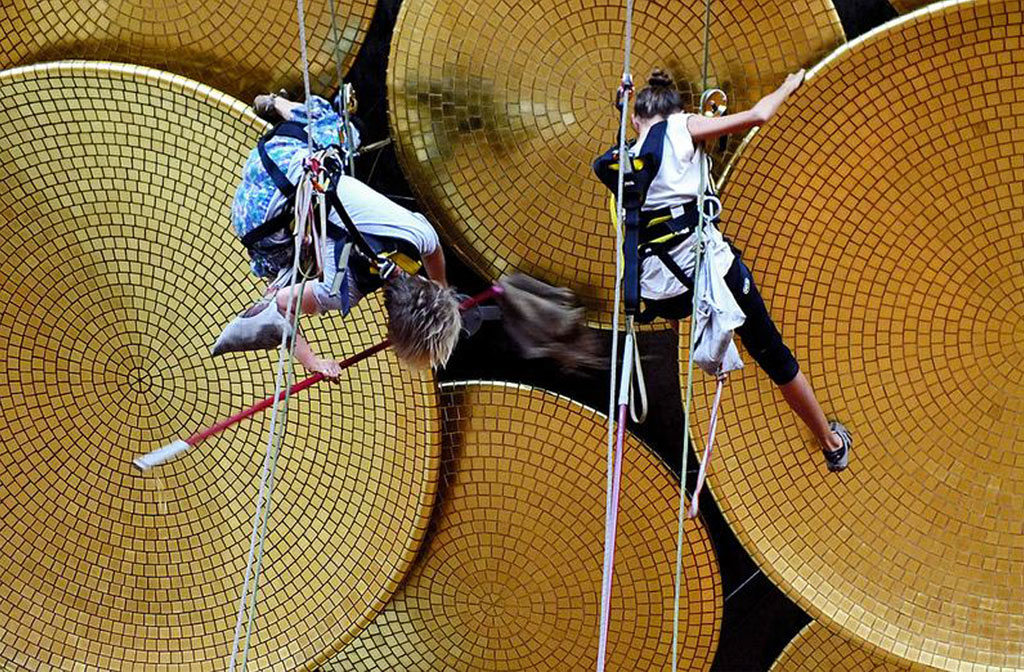
Let’s start with the cover image for the article, below.

I’ve emailed the creator of the image, Cristiana Couceiro, and if she responds after I post this, I’ll include it in the endnotes. I’ve asked her who commissioned it, The New Yorker or the author, and what were her instructions or guidelines in making this composite image, since she didn’t just make it like this out of the blue. It’s designed for effect. And since it’s the lead image for the article, a manipulated photo of the Matrimandir, which is a spherical meditation hall several stories tall in the very center of Auroville, India, what the author calls the Mother’s Temple (to achieve an effect, to misinform), it would seem the author is trying to label Auroville a cult— after all, this is an article about cults—, but actually something more subtle, but equally misinformed, is the author’s aim.
The image is for the American mind, and it’s obvious propaganda. The spaced-out or stoned hippies worshipping whatever, the four people dressed in white and sitting cross-legged involved in some ritual, the bleak, black hills on both sides, the large red halo around the Matrimandir, which would conjure up communism to the aforementioned mind, the black flag on top with the giant Q on it, which would call to mind both QAnon and the flag of Islamic State, all come together to make you feel revulsion towards cults in general and Auroville in particular (once you see the large sphere the image revolves around is being used as a symbol for the township)—deserving the black lightning bolt or giant doom-crack that hits its Matrimandir. But why is Auroville the central piece of the cover image, its focus?— I mean, considering the outright bad intentions and actions of the other organizations in the article, such as the cult-like group Aum Shinrikyo, which killed 13 people in a sarin-gas attack on the Tokyo subway. You’d ask why Auroville is in such bad company to begin with.
The article begins with a detailed examination of Keith Raniere and his cult-like organization NXIVM. He had an inner circle of women whom he used as ‘consensual’ sex slaves, had them tattoo his initials on their groins, among other things. Zoë, in citing the lessons of #Me Too, absolves the women of complicity, arguing they are innocent victims but arguing at the same time that if they committed crimes as such slaves, they are responsible for their crimes and are to be held accountable: “While brainwashing is seen to have nullified the consent of Raniere’s DOS “‘slaves”, it is generally not felt to have diminished the moral or legal responsibility of women who committed crimes at his behest.” I include this illogical contradiction on the part of Zoë to demonstrate her tendency to try and make reality conform to her idea of it, which is very much in keeping with the magazine’s worldview she’s writing for and the media conglomerate’s that owns it, Condé Nast, something I’ll return to later on.
It’s a contradiction because the women are innocent of engaging in acts of sex and sadomasochism with him and each other (or others) and therefore considered victims because of his power over them but guilty of those same things if they broke the law, for example if a minor was involved. If it’s recognized that he had the power over them to make them do things against themselves and others, why is it that if something was against the law that power is null and void, when law itself is a human convention based on culture and subject to change at any time and not a feature of inherent reality? For example, age of consent laws vary from country to country. Either he had power over them to coerce them into doing things or not. Drawing a line with law is arbitrary, based on the ideas of a society’s morality and not whether or not he had control over them.
Although you’d have to read the article, and I think you need to so as to see what I’m saying, Zoë does quite a tap dance to present that contradiction, trying her best to cover all her bases and not sound as if she is trying to stretch reality to cover her own personal opinion, quoting this book and that research to try and make herself sound objective, like she is just speaking the norm and not also her own opinion. The fact is, she has an agenda, and she manipulates language and the facts to achieve her aim, what, I’ve said, this blog post aims to show in regards to her discussion of Auroville, the Mother, and the Integral Yoga.
But Zoë is no hack. She’s excellent at her craft. Before she gets to the discussion of Auroville, the Mother, and the yoga, she’s taken the reader far beyond cults, shaken the tree of religious faith itself. And how well she’s done that. While still calling the ‘recognized’ cults she mentions a cult, she broadens the use of the term to include the religions of the earth: “Religion, as the old joke has it, is just “a cult plus time.”” She does that, however, in way that you wouldn’t take her seriously, as though she’s just throwing it out there. But she doesn’t just stop there. She goes on to suggest, seriously now, that the belief in a higher power is a pathology. That’s going for more than just religion and God; that’s going for anything that smacks of Spirit. For the astute reader, this article isn’t about defining and discussing cults; it’s an attempt to discredit any believe or faith in, or knowledge about, anything that doesn’t fit into the mainstream materialist scientific paradigm, but I would add that she doesn’t know that one can have knowledge about such things, and not only believe in them, something I’ll expound on at post’s end.
It would not be fair to Zoë to just point out the faults in the article, her overreaching persuasion being chief. Sometimes when she’s talking about people who’ve joined cults, her humanity shines through, some understanding, though not, I should say, for cult leaders (they are the bad guys). Both in the words of one such person, a woman who spent 15 years in the Children of God, and her own words, you get some picture of the caring and understanding person beneath the modes of persuasion:
“Despite Hough’s enduring contempt for those who abused her, her experiences as a minimum-wage worker in mainstream America have convinced her that what the Children of God preached about the inequity of the American system was actually correct. The miseries and indignities that this country visits on its precariat class are enough, she claims, to make anyone want to join a cult. Yet people who choose to do so are not necessarily hapless creatures, buffeted into delusion by social currents they do not comprehend; they are often idealists seeking to create a better world. Of her own parents’ decision to join the Children of God, she writes, “All they saw was the misery wrought by greed—the poverty and war, the loneliness and the fucking cruelty of it all. So they joined a commune, a community where people shared what little they had, where people spoke of love and peace, a world without money, a cause. A family. Picked the wrong goddamn commune. But who didn’t.”
I can’t help to suggest, though, before I get to her discussion of Auroville, how nicely this fits into it, as Auroville aims to be a city of love and peace, one without money (that’s in the Mother’s guidelines for the township), a place for idealists to lay their head. Indeed, who didn’t pick the wrong commune? I mean perhaps this is what Zoë’s getting at, that Aurovillians sure did (and do, to put our eyes on now and the future, as I think Zoë’s eyes are there). I’ll make the case in the end that her discussion of Auroville has a central place in her article, and peppered throughout, it seems, is a writer preparing her field.
Starve a bit and snoring
in the spiritual call for Auroville.
Spray
function might be bad.
I’d be a thousand embarrassed.
Her breathing shuts off and she reads the manual.
Let’s say Auroville is just a stand for your community,
makin’ it to survive.
You don’t just say human unity.
You got to go there.
Can we rob you?
You get pilfered—
hands in your own house.
Do your own,
a lot of work,
a lot of years,
to make a Japan,
a beautiful accessed garden.
We’ve grown the Mother on trees.
Who’s coming?
I don’t think you even know yourself.
No fights over guidelines.
That’s what’s working:
yeah, I use it,
adaptable to common sense.
She’s real.
Did I say she’s real?
She’s comin’ in her own hands.
We like visitors.
Auroville’s faith
is sitting on a time clock.
The time is coming
Auroville gauges human worth
and becomes a human unity model
for the rest of humanity.
That’s how people will gauge her worth:
she stands there and counts human unity
in every behavior on earth,
no matter what they are.
That’s Auroville’s dawn.
Whatever Auroville’s current and past failings in regards to its purpose, which is to realize human unity, it’s still its purpose now and always has been, the reason the international township was created, the main reason UNESCO has passed multiple resolutions (the latest in 2017) to support it, why the Dali Lama visited it twice, once in 1973 and again 20 years later, why various people and organizations from around the world support it morally and financially, why youth representing 124 nations and all the states of India brought soil from their homeland to its inauguration ceremony in 1968. Neither in the beginning nor at any time in its history have you had to be a devotee of the Mother or a practitioner of the Integral Yoga to join Auroville, and at any given time the devotees and practitioners have made up a minority of Aurovillians, although a transformation of consciousness always has been a central aim of Auroville, though not of every Aurovillian. While Auroville makes a big to do over not encouraging religion there, preferring people on the spiritual path, any such path, it does not forbid religion either, and you’ll find many Hindus and Buddhists there as well as people of no particular spirituality, even some skeptics. Being a person of goodwill is the bottom line, not being spiritual-minded, despite what its charter says, which is that “to live in Auroville, one must be a willing servitor of the Divine Consciousness.” It’s precisely here it goes astray, foregoing that, in my opinion. Whatever the case, the Mother, Sri Aurobindo, and the Integral Yoga are highly respected by most everyone in Auroville, are its guiding light.
Under the guise of reviewing a book, Better to Have Gone by Akash Kapur, who grew up in Auroville, left, and then returned there to live some years later, Zoë states her rather strong opinions, using the material in it, it seems, to be sole source of the matters at hand and using the author’s understandings (or misunderstandings) of the Mother and the Integral Yoga as the standard way they are understood by all her disciples and students of the yoga. A writer of this stature just doesn’t do something as sloppy as this without being conscious of doing it, without doing it for a reason. The book of course is a foil, as is the article itself being billed a ‘book review’, when it’s more a feature article about cults that underneath it all is really about slamming faith.
“She [the Mother] intended Auroville…to be the home of integral yoga and the cradle of a future race of immortal, “supramental” men and women.” Zoë has taken some scattered facts (from the book?) and twisted them to suit her purpose, which is to make Auroville sound like more than just an impossible dream— make it sound utterly ridiculous, at least in its inception. The Mother intended Auroville to work out human unity, not to be the home of the Integral Yoga. The Mother did not say she founded Auroville to create a race of immortals. Auroville was, in her mind, to be a cradle of a new humanity based on human unity and the realization of its innate divine consciousness, what the word supramental means. Such a realization would also involve a transformation of the body, making it not immortal but more plastic to infinity. It is the wearer of the body that would be immortal, able to take a body off and on as one would a set of clothes, and I’m paraphrasing the teachings on the matter of both the Mother and Sri Aurobindo. It should be mentioned that this process would not happen overnight but take a very, very long time.
However impossible such may sound to the atheist and skeptic, and to most religious-mined people too, to whom it would sound blasphemous, it’s not too terribly different from an aim of the science-minded transhumanists. In other words, it’s not an insane aim, garnered only by loons. And a transformation into a divine consciousness has been a feature of Indian spirituality for at least three thousand years. When you check the facts, read more about Auroville than just that one subjective book, it’s apparent Zoë isn’t being objective. One would ask, repeatedly, why is Zoë purposefully trying to make Auroville sound bad?
Her treatment of the Mother is an attempt to make her out to be a cult leader. “The Mother does not appear to have had the totalitarian impulses of a true cult leader, but her teachings inspired a cultlike zealotry in her followers.” By saying “does not appear” and “true cult leader”, she’s casting doubt in the reader’s mind as to whether she was one or not, and by adding “her teachings inspired a cultlike zealotry in her followers,” she’s saying basically that it’s a moot point because, for all practical purposes, she created a cult; i.e., her follows act like cult members. As a point of fact, only a small fraction of her followers are or have been fanatics, by no means all, just as only a small minority of Aurovillians lost the plot after the Mother left the body and gave people like Zoë material to damn Auroville.
It’s the worst moment in Auroville’s 53 year history, and it’s the moment Zoë focuses shows us. It sounds terrible, as does the storming of the U.S. Capitol, but just like that insurrection does not show the essence of America, shows the very things contrary to it, the “cultural revolution” in Auroville, as Zoë puts it, does not capture the heart of Auroville, neither in the beginning nor now, instead shows the enormous obstacles it faces and has always faced in achieving a workable human unity. It’s characteristic of the times to focus on the ‘sin’ of someone or some organization, not more on their talents and achievements, and I use the word sin so to bring in a religious connotation, since the tendency to point out the bad comes from a sense of self-righteousness, another major feature of our morally indignant times.
She writes of that moment: “When, five years after Auroville’s founding, she failed to achieve the long-promised cellular transformation and died, at the age of ninety-five, the fledgling community went slightly berserk….To preserve the Mother’s vision, a militant group of believers, known as the Collective, shut down schools, burned books in the town library, shaved their heads, and tried to drive off those members of the community whom they considered insufficiently devout.”
Any student of history knows, especially today, there’s always more than one version of tumultuous events in a people’s or a place’s history, and there’s usually more to the story. A writer of any history has to pick and choose what to include, Zoë, as I’ve pointed out, picking out the worst, and we want them to tell the version of events as close to the truth of those events as possible, not flavor or color them to fit an agenda, ideological or otherwise, something being argued about ad infinitum in today’s world, the conservative crowd being accused left and right of writing history to their agenda, and here’s The New Yorker, a standard bearer of liberalism, publishing a piece of a writer doing that same thing.
What immediately happened upon her death was that the Sri Aurobindo Society came to take over Auroville, the organization the Mother had appointed to do so, and Aurovillians greatly resisted this take over, since up until that time Aurovillians had basically ruled themselves, with the guidance of the Mother at a distance. The battle for control, which lasted years, what the moment under the microscope was a part of, ultimately resulted in Auroville losing its autonomy to the Indian government. Douglas, whom I share this blog with, in researching for this post, has interviewed an eye witness to that tumultuous time, as well as all the history of Auroville thereafter, a European Aurovillian and disciple of the Mother and Sri Aurobindo, who came to Auroville in 1972. (The Mother died in 1973.) Here’s a slightly edited version of their online chat, his speaking put in italics:
“When Mother died, many things happened, first of all from an organisation outside of Auroville, trying to take it over legally and practically. It is in sheer reaction to that very real danger already starting to take effect at the time, that also from within Auroville a group formed to defend, or so they believed, the authenticity of the way the teachings of Sri Aurobindo and the Mother were being followed. They went too far, for sure, but all this has to be put back in context instead of being blown out of proportion and used to ‘prove’ one’s misconceptions about Auroville.”
“So this group that defended the teachings was called the Collective and did these things stated in the article shortly after the Mother’s death. Is that correct?”
“Yes, that’s when that specific episode happened indeed, but as I explained, it was only after much more violent things had been committed against us (including women and children) to try to starve us all, and to scare us all enough to make us leave, as simply cutting our visas under false accusations [and] had to be discontinued because the Indian Government noticed something wrong was going on with that outside organisation… since the time when the Mother had left her body. During that whole period after November 1973, it has been one long terrible time that can’t be separated. The Aurovilians had been under attack through all forms of more and more devious means by that organisation. Whatever is being singled out in the article, at least none of us Aurovilians has ever beaten up with sticks anybody, even though that was what was being done to us.
Most of us then in Auroville were part of what in the article is supposed to have been called ‘the Collective’. But only a small group within it took the actions incriminated in the article, which haven’t met with the approval of all, but on the contrary have been condemned as quite excessive and unnecessary by the many much more moderate persons in the Auroville mainstream population (including me) that, to my knowledge, never called itself officially ‘the Collective’. Or it has been only for a very brief period, before the situation found again its own balance, the small fanatic group soon dispersing or going away, and the other small groups of various opinions merging again with the mainstream one, that from then on was again simply ‘Auroville’. The differences and antagonisms of that traumatic time are now remembered, if at all, only for the deep lessons we all learned then about this Unity in Diversity which is the very Aim of Auroville.”
Didn’t go berserk.
Getting the picture.
Well they all go down and pick on people,
that Society.
Hello?
That was a dangerous time.
You know government,
it’s always taking over
too much.
Share a footage,
someone who knows it.
It’s not the same
as the account in the book.
Why do we have a difference?
So many tellings.
Going to get up front,
if we let it happen,
the truth be told.
Where is Zoë?
I need to also
make them look bad,
the whole Auroville thing.
Now, we consider that good?
Okay one moment.
We’ll come back in a month.
We’ll give tomorrow.
Everybody needs some distance
from these troubled times.
And I’m goin’ up the ladder,
up the ladder.
We cast out on yesterday, today, and tomorrow.
Give some idea of pluralism.
That’s from cults.
And I was trying to—
Zoë’s own words.
Rascal.
Do you have everything?
The ideal action.
People act like they’re possessed when they chew on these things.
Things on order.
I put it on safe.
You hear it?
In regards to the Mother’s death and beliefs concerning it Zoë tries to paint a different picture than the facts of the matter, but it’ll take a moment to present them. Zoë writes, using a quotes from the Aurovillian’s book: ““She never prepared us for the possibility that she would leave her body,” one of the original community members tells Kapur. “I was totally blown away. Actually, I’m still in shock.”” It is true some were shocked when she died. Did the Mother actually say she was never going to die? No. People will believe what they want to, both insiders of the yoga and outsiders. In the Western spirituality of today choosing which Eastern spiritual figure to follow, the Mother is billed as the laughable person that said she wasn’t going to die, and she died. End of story. Choose another guru. Now, what about her and death? She taught that it could be overcome, eventually, and that it couldn’t take you without you letting it. She made some effort in that direction it does appear. I can’t apologize for her attempt to overcome death, only say that many have tried the same. She made many mistakes, and, in my opinion, her fight against death was one of them. But, I will say it was a noble effort, and one very costly to her. It happened that her death took an agonizing six months, where she lay in agony unable to get up or do much more than moan, although she could speak. I’m not concerned if you can’t entertain the possibility, but I believe she held death at bay for that long, had the strength of will to do that, and death only took her because she let it, once she realized it was divine will for her to. This, though, is something for the future to decide, when we have more knowledge about such things.
A brief introduction born.
The Mother said she could fly?
She quoted Shakespeare.
It was not her contradiction.
In the availability of death,
it has to be purchased.
She didn’t do that
until those final days I’ve recounted.
I’ll recount.
It was all funny and everything,
that strong battle for control.
Six months she lay there
doin’ it.
Then God gave her permission to die,
and she left on her own accord.
Can you just get that out of your craw?
What was that imagination at doin’ yellin’?
Broke my leg.
Ha, ha, ha,
divine human.
Is that how fences go?
In a little while that fear will be gone too:
the guru,
they have to be perfect.
Now go to sleep.
Do we have it online?
Three fiction story,
which lasted for years:
Mother would never die
said the Mother;
they said they were Gods;
we are conclusion they said.
They kept going.
It’s more difficult.
It’s a manifestation of the divine mother,
her soul.
A common soul
took no form.
Go put it somewhere man:
why did the Mother make mistakes?
She was a garden growing.
The soul is one thing the outer personality another.
What happened?
She didn’t come all the way to the surface,
the divine mother.
I looked.
It’s in her description.
She tells you the divine mother.
Oh you didn’t what?
I’ve given you some clothes to grapple with.
Understand the name.
It’s his way of calling her
the ashram’s joy.
Are we going to go to sleep here?
We’re gonna rock the boat.
That’s the plug.
Is that enough room?
Go sweetheart.
Zoë uses the term cellular transformation in a misleading fashion, due to in part, perhaps, to the way the author of the book sees it. Zoë would have done well to do a more varied research on the Integral Yoga. Like any religious or spiritual organization that has been around awhile, the yoga is divided into different groups at odds with one another. One group, aligned with a favorite disciple of the Mother, Satprem, to whom she dictated a multi-volume work to entitled The Agenda, focuses rather disproportionately in my opinion on a transformation of the cells, a major theme of the aforementioned work. Perhaps, as I’ve mentioned, the author of the book holds such views. I don’t know. I haven’t read it (it’s publication date is July 20, 2021, a couple of days ago). At any rate, that group is not the mainstream of the yoga, and cellular transformation is only a part of the transformation of the body, which is itself only a part of the supramental transformation, the change into a divine mind, life, and body, the aim of the Integral Yoga.
The transformation of the body is, as I’ve said, something that takes a very long time, not in terms of the years of someone’s life but in terms of the maturity of the human race, and it isn’t possible to complete on earth at this time, nor will be for a long time to come, to paraphrase the Mother and Sri Aurobindo on the matter. The Mother never promised that she’d complete the transformation of the body or its cells. So when Zoë says the Mother promised to do that, she’s twisting facts to suit her need. Put this way, that the Mother failed to fulfill this all-important promise, it makes the Mother sound like a total failure, a loser— Zoë’s aim I’d argue. And by using the term cellular transformation, as opposed to a more usual term such as a transformation of the consciousness, and saying that the goal of the yoga is immortality, not to realize our divine consciousness, called Supermind in our yoga, she’s once again trying to make the Mother and the yoga sound as silly as she can, so you wouldn’t take either seriously. What she isn’t able to do is to make them sound sinister, have that badness inherent of cults and their leaders, try as she might.
In showing the common characteristics of cult leaders, Zoë writes that often “they style themselves as the fathers or mothers of their cult “families””, and they do this so to gain the kind of dependence and submission small children give to their parents. Enter the Mother, showing this characteristic of a cult leader. When you know that it’s common in India to call the wife of a guru mother or the mother, and that the Mother didn’t name herself that, and that Sri Aurobindo did, her being called that fits more into the milieu of Indian spirituality than that of cults. You’d wonder whether or not Zoë had the coming exposé on the Mother in mind when she wrote about that parental characteristic. Was she preparing a field? Since it is a characteristic of cult leaders (as well as leaders in general I might add), and Zoë is just covering her topic, that would seem to be an unnecessary speculation, but it sure does lead nicely right up to the Mother. As I’ve said, since neither Auroville nor the Mother (nor the yoga) fit into the article as examples of a cult and cult leader on a par with the cult-like organizations mentioned, you’d ask why they are there and if trying to make, not so much modern day Auroville, but the Mother and the yoga out to be such, is an important aim of it.
I think, other than the concept of Supermind, the relationship between the Mother and Sri Aurobindo is the least understood item in the Integral Yoga. If you do a search about it on the net, most of the results you get call them collaborators, and that’s not far from the mark (why didn’t Zoë do that search? Of course she did). For those of us in the yoga, we understand that it was created by both of them, together, even though at the onset, when the Mother first arrived in Pondicherry to stay, she was called by her given name, Mirra, and she was his disciple like the rest of the small group gathered around him in the early days. This changed dramatically after a decisive spiritual experience of Sri Aurobindo, from which he returned calling her the Mother and asking everyone else to too, putting her on equal footing with him in the creation of the yoga, and putting her in charge of the forming and management of the ashram. Not everyone was happy with that, and neither does Zoë seem to be, because she calls him the Mother’s guru, not her collaborator, saying she “claimed to have learned” the secrets of immortality from him, and I’ve paraphrased what Zoë writes.
This is misinformation, manipulating the facts to make false or misleading conclusions: both that he was her guru (he was only for a short time) and reducing the Integral Yoga to a process of effectuating cellular transformation so to achieve immortality, when in reality it is the Truth Consciousness (Supermind) and the corresponding divine life on earth that results from that, not immortality, that the yoga aims for. I’ve already put a cellular transformation in its place, within the framework of a transformation of the body, which itself is within the framework of a transformation of the mind and vital (the life-body, composed of the life force, impulses, and desires), all of which make up the supramental transformation, something that will not be possible in its completeness for generations, what Zoë either misunderstands or purposely leaves out of the discussion (I think both), only using the word supramental to add more weirdness to the effect she’s trying to achieve, which is, as I’ve said before, to discredit Auroville, the Mother, and the Integral Yoga, make them appear ridiculous.
As I’m showing, along with twisting the facts, Zoë’s method is to make things sound lower in worth than they are, debase them, like when she calls the Mother Blanche Alfassa and not Mirra Alfassa, what she called herself (before she was called the Mother) and what others called her, what you’d find her called if you googled her. Blanche is her first name, which she chose not to use (her full name is Blanche Rachel Mirra Alfassa), and I’d bet that Zoë is very careful when it comes to a trans person not to use their dead name, and so why is she using a name the Mother didn’t use? Because the book does? You don’t know, but Blanche sounds more humdrum and perhaps a little bit bitch-like, at least to American ears I’d imagine, pronounced as English, and Mirra has a better ring to it. You would know that Zoë knows she’s called Mirra Alfassa, unless you actually believe she never looked at anything about her other than what’s in that one, single book.
Zoë also uses words and terms set off in quotes to lessen the value of her subject, not necessarily to qualify something. For example, she does that to the term intentional community, which is like putting doubt in the reader’s mind it is one. She does this also with the term integral yoga, as if to suggest it’s not integral at all, and with the term cellular transformation, like she’s laughing at it under her breath. I could go on, but you get the picture. It’s interesting she doesn’t give the yoga the respect of having a name, never capitalizes the first letters of integral yoga. That’s also a way to debase something. Now, it could be the Aurovillian’s book she’s reviewing doesn’t call it by a proper name, but nonetheless she’d know the yoga has a name, and she chooses not to call it by one. It could also be that in her use of terms set off in quotes she’s quoting from the book, but there’s no way to know that, and she would not be blind to the fact that readers might take that as ‘qualified’ material. (It’s a fault of the American style to use double and not single quotation marks to set off some word or term you want to qualify— leads to confusion, as you see here.) Whatever the case may be, if you’re really paying attention, you’ll realize it’s not Auroville Zoë’s after, that’s stuck in her craw; it’s the yoga and the guru, because this article, as I’ve suggested, isn’t really about cults, or that’s not its bottom line. Religious and spiritual faith is and the people that people look to to grow it. Just read the summation of her discussion of Auroville, the yoga, and the Mother:
“Kapur gives too sketchy a portrait of present-day Auroville for us to confidently judge how much of a triumph the town—population thirty-three hundred—really represents, or whether integral yoga was integral to its success. (Norway has figured out how to be “somewhat egalitarian” without the benefit of a guru’s numinous wisdom.) Whether or not one shares Kapur’s admiration for the spiritual certainties of his forefathers and mothers, it seems possible that Auroville prospered in spite of, rather than because of, these certainties—that what in the end saved the community from cultic madness and eventual implosion was precisely not faith, not the Mother’s totalist vision, but pluralism, tolerance, and the dull “compromises and appeasements” of civic life.”
Are gardener minds to rob the world?
Found is a slave.
And we just bubble them.
I just have to ask. If Kapur’s portrait is too sketchy, why didn’t Zoë do a more thorough research on present-day Auroville than this one book? Of course she did. Then why this sentence to begin the paragraph? To fain to continue her discussion within the confines of one single book she’s ‘reviewing’, to cast doubt upon the success of modern-day Auroville, to give information about it, i.e., its present population, but primarily to introduce the main idea of the paragraph, which is to discredit the Integral Yoga, and by that all faiths. And with the next sentence, set off in parenthesizes, she takes her secondary aim and shoots at gurus, and by that at the Mother.
The book is an excellent opportunity to give a bad press to the Mother and the yoga, why, I’d imagine, Zoë frames the discussion by it. The Aurovillian author describes how his wife’s parents, both pioneers of Auroville, die because of their faith in the Mother and Integral Yoga. They both refuse medical treatment, the mom after she has a fall from the Matrimandir while helping build it, and she relies on ‘cellular transformation’ to heal her but ends up paralyzed and unable to walk, and she commits suicide after the dad dies of a parasitic infection he refused treatment for, and she does so to be with both he and the Mother. As a point of fact, both the Mother and Sri Aurobindo were treated by medical doctors in emergencies (he had a personal live-in physician, Nirodbaran, one of his closest disciples), and the ashram in Puducherry has a clinic with attending medical doctors for sadhaks and visitors to the ashram, and two care homes for its elderly, with nurses and attending physicians, one of which is used also as a hospital for its members. However, both the Mother and Sri Aurobindo did not have very much faith in nor encouraged faith in medicine as it’s practiced today, as a total dependence on tablets and antibiotic injections atrophies our own ability to heal ourselves (the Mother spoke about this and he wrote about it frequently, concerned as they were with not only spiritual enlightenment but also a transformation of the body), and they would not use medication unless absolutely necessary, such as when he broke his thigh bone and asked for pain medication, and he stuck it out over a day before he did. He also refused to wear glasses to correct his failing eyesight (in my opinion an unnecessary suffering; I wear them for reading and writing). These would be the reasons some disciples refuse medical treatment, going to an extreme in their faithfulness to their spiritual teachers or prophets, a tendency of us when following such people, especially after they die, such as the requirement in some Muslim communities and countries for women to wear veils, when Mohammed himself only says in the Quran that women should dress modestly. In regards to suicide, the Mother spoke at length about how, if you do that, upon dying you face in your face the very things you’re committing suicide to get away from, so Zoë can’t put that at the Mother’s feet and say she’s responsible for it, what she’s implying, indeed, that she’s responsible for both deaths, not her two disciples, with their rigidity and fanaticism. It’s a little like they are being made out to be victims of the Mother and her ‘totalist vision’, something certainly implied, “called in her like a mess that was burning” (my muse).
I would assume by totalist vision Zoë means the Mother’s vision in regards to Auroville, but maybe she means her ‘total’ vision, if you’ll pardon the wordplay. I’ll go with the former. She has said previously, and I’m paraphrasing, that the Mother was not a totalitarian leader. In a roundabout way, she’s saying now, in the summation, that she was. Totalism means totalitarianism, and it’s often applied to cults and cult leaders. In any event, you can read the Mother’s vision statement in regards to Auroville.[ii] No doubt Zoë has read it. Perhaps she has also taken a look at The Mother on Auroville (Auropublications), but I somehow doubt it. Neither of those show totalism on the part of the Mother in regards to Auroville, although the latter, things she said or wrote to Auroville and about it as it was forming and getting its feet underneath it, does contain some things that just don’t seem to work, at least not yet. Where is Zoë’s evidence that the Mother had a totalist vision? As I said, it contradicts her previous statement regarding the Mother. It seems she just throws it in while making her strongest statement regarding the ineffectiveness, indeed the obstacle, of faith, what “in spite of” means in that same sentence. At any rate, as to her total vision, if by chance Zoë means that, I’d recommend she read Questions and Answers 1955,[iii] a good enough year as any, although, in my opinion, the 50’s are the best. She just might find that the Mother is more progressive, and liberal, than she is. And as long as I’m stating my opinion, let me say The Agenda is not the best work to read to see the Mother’s vision.
It’s got both your practices on it,
the firm yoga
and the Mother’s slippery slopes—
excessed matter.
She’s not a stale figure in time,
any book you read.
We just let them breathe for a better man.
Sweetheart that’s fine.
And as to an introduction to the Integral Yoga, I myself would not recommend the books written to be that. The yoga is immense, virtually inaccessible to anyone that doesn’t have a calling to it, since it takes so very much reading and contemplation on that reading to even figure out what it’s about, and you have to have an inner compulsion to spend that time and give that concentration, or you just won’t do it, unless you’re being made to for school or work. The yoga doesn’t seek converts, is rather snobbish actually and when it comes to people trying to become a student of it. And you don’t join the yoga. There is no initiation or entrance portal. Based on an inner calling, and if you don’t have that you won’t last long, you just pick it up wherever and begin, relying, if you can, on inner contact with the Mother and Sri Aurobindo as much if not more than on the written and spoken works they left behind.
Now I’ve hardly described a cult. For someone science-mined like Zoë, I’d recommend first getting a good look of how well it views the human condition before trying to find out its scope and goals. Once you do that, you’ll be in a better position to delve into it, since you’ll be confident the yoga ‘knows the score’, believe me. Start with the following works by Sri Aurobindo: Savitri (Sri Aurobindo Ashram Press) From Book Two, The Book of the Traveller of the Worlds, read Canto Four and Ten only, The Kingdoms of the Little Life and The Kingdoms and Godheads of the Little Mind.[iv] Then read The Human Cycle (ibid)[v], and then The Problem of Rebirth (ibid).[vi] After reading these numinous items, you’ll be more prepared to discover the meaning of the Supramental Yoga.
Zoë’s whole attitude towards the Integral Yoga and the Mother is a classic example of making fun of what you don’t understand and haven’t taken the time to learn about enough to understand, and you’d expect her to be bigger than that because she is a British author, a novelist, who has been writing for The New Yorker since 1994, is currently also writing for The New York Times Book Review, has written for Vanity Fair, The Sunday Times Magazine and The Daily Telegraph, and I can continue. I’d imagine she considers herself a progressive liberal, a good person, one who believes she’s trying to make the world a better place. You’d wonder what gives then, why the yellow journalism?
There’s a war on, if you haven’t noticed, and it’s a war of ideas, specifically, what consensus reality will we all share? And we have to share one in order to have a cooperative and peaceful world, one that works. With almost eight billion of us and counting, our globe is getting more than crowded; it’s getting trashed, and there are so many competing worldviews many don’t even believe that climate changing fact, think people are just pushing their agenda to control them. And recently millions of red-blooded Americans, educated in American schools, steeped in the advent of American science and invention, and embarrassing numbers of its state and national congressmen and women and its senators, believe a national presidential election to have been rigged, not based on real evidence, but because of their cult-like zeal for a political figure— he says it, over and over, and therefore it must be true. You’d understand the urgency to win the battles of the war. We need to ask ourselves, though, before we step in and add to the confusion, are we merely reacting to a perceived threat, or are do we really have something valuable, and true, to add to the conversation? We might also ask, in our zeal to defeat the false narrative, are we justified in using misinformation to do so?
From Auroville Zoë goes to QAnon, like they are kissing cousins. The QAnon conspiracy is ridiculous, but it’s being used by the powers that be to alarm everyone into a backlash against any belief, opinion, or knowledge not backed up by mainstream science. In one form or another, such a conspiracy, that there’s a group of evil people behind the ills of society, to put it in its most basic form, has been around hundreds of years, and probably much longer, and in times past it was homosexuals and Jews, not pedophiles, that were those people, (I’ve only simplified, not tried to rewrite, Western history). I first heard about QAnon, in somewhat its present form, in 2008, from someone who heard about it in the annual European Rainbow Gathering. He bought into it and actually believed that all the leaders of the world’s most powerful nations got together at various times and conducted satanic rituals involving what was called star gate, which was anally raping little boys so to open a portal to hell. He said there were people giving classes about it at the gathering. I cannot verify that fact, but I can tell you when I heard that and what I heard, and it’s not unreasonable to assume my friend did not just make it up on the spot. There was no reasoning with him, just like there’s no reasoning with the people who believe in QAnon today.
My point is that conspiracy theories such as QAnon are not unnatural to us and signs our world’s falling apart, and when we deal with them as aberrations of nature, and by making the believers of such conspiracies out to be fools and liars, we amplify the conspiracy and do not negate it. No one, to my knowledge, has yet to focus on the central feature of such a conspiracy, the scapegoat, be they homosexual, Jew, or pedophile, and see that the hatred of them, their scapegoat function in society as it organizes itself around the human ego (a function we seem to be only dimly aware of), has reached such a pitch they’re being blamed for ‘it all’. Correlating how that corresponds with things like nationalism, separatism, populism, xenophobia, ethnocentrism, intolerance, and the like reaching likewise high pitches would certainly help us understand and therefore be able to address things like QAnon better and not exacerbate them as we’re doing now. Though I’ve gone far off topic, let me add that if we viewed racism in a similar manner, as a manifestation of the scapegoat function, and not just as ignorant, hateful people being racist, we’d be in a better position to begin to eliminate it.
I’m writing this blog post because (I mean other than doing it at the Mother’s behest, from inner contact with her), the cultural powers that be, not all of those powers, but the ones with their hands on the horns of the mainstream, which are the news media, entertainment, art and literature publications, the higher education sector, i.e. university professors, and the scientific community, seem more concerned with establishing their reality (based on materialistic science) as consensus reality than accurately representing reality, than truth, truth being not some religious name or spiritual formula but what’s actually going here on this wonderful, terrible globe. Enter Zoë with her article about cults but not about cults that I’m critiquing here. The Guardian has said of her in the past: “Heller has form when it comes to hatchet jobs,” and she’s establishing a reputation for “disemboweling” writers of books she deems badly written.[vii] (It wouldn’t be fair not to mention Zoë ‘s take on the matter, which is that she wrote the review The Guardian article’s about “in a pure spirit”, not to attack anyone.)[viii] I cannot help but wonder whether or not Zoë wrote this on her own and submitted it to The New Yorker, or she was asked to, since, in her fiction, journalistic pieces, and interviews, she’s often an outspoken atheist and critic of faith, would be one to turn to in order to write an article debunking it. The question isn’t of critical importance because, whatever the case, The New Yorker published it, showing they too are interested in discrediting religious and spiritual faith and the leaders and teachers that grow that, and they are willing to publish yellow journalism and misinformation to do it.
After reading other articles by magazines also owned by Condé Nast, such as “What the Pentagon’s New UFO Report Reveals About Humankind” (Wired, June 2021), which does not use misinformation but does have an underlying perspective, as stated in the title, one similar in fashion to The New Yorker article but broader in scope, one that, in a very subtle manner, belittles our “continued need to believe in something beyond our mundane experience of the world,” you’d wonder whether or not Condé Nast has an editorial input, an agenda.” The Wired article ends:
“Ultimately, no report is going to do much to move the needle for either side. What any given person thinks about UFOs comes down to their personal cosmology and the underlying truths they see in the world. As Fraknoi noted, the belief in alien visitors mirrors people’s faith in other kinds of spiritual protectors, like guardian angels. “A lot of these UFO reports are people wishing we had alien godparents that we could consult about our problems,” he says. “For the most part, I think we have to solve our own problems.””[ix]
Without actually stating it, Wired implies its own cosmology in a manner well within the criteria for an ‘objective’ article (complete objectivity is an impossibility for anyone, and neither is it wrong to promote a worldview, as long as that’s not done underhandedly), their worldview being that there are no higher powers to help us, nothing other or deeper than the mundane, everyday reality we see. Is Condé Nast promoting this agenda? Even if it’s not, we still need to ask the question, since only a handful of media conglomerates already own most of the press in the U.S.,[x] and the entertainment monolith Disney is buying up all the ‘imagination franchises’ of Hollywood,[xi] putting itself in quite a position to influence children worldwide, and Internet monopolies such as Facebook and Google are buying up as much of ‘viral’ as is feasible for them to, gaining quite a control over the conversation of the Internet, and you have to wonder if these companies are not just interested in making more profits but are interested also, keenly so, in winning the battle for consensus reality. All of the companies I mentioned (with notable exceptions such as the owners of Fox News, who give some preference to the Christian faith, not, I’d add, all faiths) subscribe to scientific materialism, not their each and every employee, but, other than a strong belief in capitalism and a democracy based on that, it would be the company’s ideological bottom line.
By using the term scientific materialism to describe the worldview of so very many people, I’m being rather narrow for brevity’s sake. What I mean to say is that those cultural powers that be and the people providing content for them, such as Zoë Heller, see “science as the leader in life” and “as the truth giver / for the principle arms of humanity, / for her mind think” (my muse, from The Literary Eye, an epic poem being considered by one of those powers). Although science is just beginning to address consciousness as a thing in itself, and as a result will inevitably open its doors to the unseen, entertain the discoveries of the mystics (not anytime soon), science is basically materialistic in its view of the universe, quantum physics notwithstanding, does not believe in either higher powers (God or an Absolute, Gods, Goddesses, angels, divine beings), or lower powers (demons, asuras and the like), or that there are higher and deeper realities (other than an ‘insentient’ quantum field and some vague notion of other universes, nothing, I’ll add, about larger things than universes)—the mundane world is what you see and what you get.
The culture war I’m pointing out is basically, in one form or another all over the world but in America most pointedly, being fought between conservatives and liberals. But I would argue there are very few true liberals, and that most everyone is conservative in that they view the human being and react to him and her in the same fundamentally conservative way, what I’ll return to in a moment. To be a liberal, in its essential sense, as that’s generally viewed and not given the deeper and more integral meaning I assign it, means being concerned with issues of power, specifically between the individual and the government, but also between minorities and majorities, and that the former has intrinsic rights to express themselves without being stomped on by the latter, and that society needs to constantly progress to create a more perfect balance between those who have power and those who don’t, with an aim to eliminate power differences as much as possible and within reason and give everyone an equal status in terms of the power to self-determine their lives and livelihood, and I’d argue that there’s a sense, however hidden now, of creating a more ideal society, of progressing beyond our present state. Being conservative means, basically, to maintain the status quo in terms of the values, social, racial, ethnic, national, political, religious, etc. a person who identifies as conservative has experienced all their lives. In the future, the war will be fought over a fundamental change in the fabric of humanity, once that possibility becomes visible, whether it’ll be believed in or not by the people who oppose it, but such isn’t even on the table today.
I mean that there are very few liberals because, whether we are talking about Zoë Heller, most certainly a liberal by identification, or Rush Limbaugh (deceased), who was a conservative by identification, or whatever liberal or conservative we put side by side, they both would I bet share the same fundamental view, in one degree or another, of the human being and react to him or her in the same way, and that is: that the human being is a separate individual from every other human being, does not share a field of consciousness nor identity with all other people; that the formula of oneness is not the underlying formula of the universe, the ground of everything; that we have absolute free will, and no mitigating circumstances, a spell of rage or lust for example, or being severely abused as a child or even being raised as a child soldier or in such violent arms as Islamic State, excuses criminal behavior; that there are no hidden wills, such as that of the community (or lower powers), involved in the criminal actions of an individual to the point that the community also bears responsibility and not only the individual; that law and retribution (punishment), carried out by the state, is the only or primary way to prevent wrong and address wrong done, is what justice is, what ‘heals’ victims; that goodness means having goodwill to people who do good and ill will for people who do wrong; that people who do wrong have lost much or most of their worth as human beings, indeed, that you judge people in moral terms, and criminal behavior nullifies any good they have done, achievements they’ve made, or talents they have; that the outer world is reality, the inner being subjective and personal, not to be given the same attention or weight as the outer, indeed, that from the outer the inner world arises and not the other way around, and therefore things such as dreams might be interesting and even meaningful, but not enough to give them as much weight or more as outer media in determining the course of life, not enough to spend a lifetime also getting an education on their interpretation; that there is no secret inner consciousness to open and explore; that our name and corresponding personality are who we are, and there is no deeper or higher self we truly are; that the world is to be taken at face value and is not a representative model of a larger reality, life only a field for the aggrandizement of the individual and/or the group, though one socially responsible and morally fit, and life is not a stage, movie, or video game (using known terms to confront the unknown), and therefore every real or perceived wrong done to us or whom we value is an affront to nature and should be reacted to as such, and I can continue, but that’s enough to get the idea almost everyone on earth is a conservative. I wouldn’t imagine Zoë holds all of these things to the degree Rush did, for example the ill will towards ‘criminals’ (her bringing in Norway, which focuses on reform and not punishment, makes me think this, and the matter of fact way in which she talks about people, like Keith Raniere, who have committed grave crimes, and, although it’s clear she doesn’t have goodwill towards such people, she avoids calling them monsters or being sensational in discussing them), but I’d imagine all the items and ideas I’ve listed are very much a part of her worldview too. Few people would view and react to us differently. Those, I argue, are true liberals. They are more than that; they are the forerunners of the advent of the new human being.
Although many would disagree with me on the above, people who identify as liberal and who also hold a different fundamental view of the human being, a spiritual one, like most Aurovillians and sadhaks of the Integral Yoga, as well as most spiritually-minded people, who hold a view of oneness and/or unconditional love, it’s been my experience that, when it comes right down to it, encountering one such as I for example (see the muse below that ends this post), they hold the view I show above.
Like most science-minded people, Zoë does not know we can know and not only believe answers to the big questions in life, and she probably doesn’t even believe we can answer them, as science nowadays is using that belief, that such questions are unanswerable, as a means to avoid them. This article, for example, shows her walk towards meaning but not arriving, and when you finish reading it, you hold nothing of value in your hand that you can definitely say has been a revelation to you, although she’s presented interesting facts. It, like I said, was written to get you to believe in the doctrine of the mainstream cultural powers that be, which is that religious and spiritual belief are pathologies, although she never comes out and says it. The biggest danger to that doctrine is personal spiritual experience, our own narratives of such, our stories. “They proved to me by convincing reasons that God does not exist; Afterwards I saw God, for he came and embraced me. And now what am I to believe- the reasoning of others or my own experience? Truth is what the soul has seen and experienced; the rest is appearance, prejudice and opinion” (Sri Aurobindo).[xii] Science would have us distrust our own experience if it contradicts its beliefs. Zoë would too, and she very cleverly casts a measure of doubt on the phenomenon of story itself. She writes:
“Bernstein…argues that our propensity to go nuts en masse is determined in part by a hardwired weakness for stories. “Humans understand the world through narratives,” he writes. “However much we flatter ourselves about our individual rationality, a good story, no matter how analytically deficient, lingers in the mind, resonates emotionally, and persuades more than the most dispositive facts or data.””
The principle bias with which we live.
Tell me in front of the United States.
Tell me something.
Death is right here,
and we don’t
think it’s for real.
A Luna protective script?
Wow, protecting Iran.
Are we gonna get any idea at all
about love of God?
And the love of God complete?
Able to take eternity in our single breast.
Every check this world is claimed
an institute of no derelict of searchology, but
when results are forthcoming we accept them.
Wow what a major burn.
Is that consciousness?
Don’t give it the weight of reality.
You hear me guys on TV?
Wham, bam, thank you ma’am,
my education is complete.
All these titles with my name,
and my consciousness is unknown to me.
I don’t even investigate my very own dreams.
There, there science.
Is that reality they’re studyin’?
What do we sit in day and night?
You mean consciousness holds us?
It’s not the scientific paradigm.
Gotcha!
We have means to judge the truth value of a story, but there will always be a measure of belief involved in accepting it as fact, even for such mundane things as someone’s trip to Norway, if you haven’t actually been there yourself and know firsthand the country exists. You can imagine, that before the fame Columbus’ voyage brought to the Americas, the existence of such land between Europe and Asia was either unknown (by your average European at the time) or considered a myth, even though others had been there long before Columbus. It will be the same with the higher modes of consciousness and our larger and deeper selves. They’ll be a 100th monkey moment, that will stretch for some time I’d imagine, and one day they’ll be as known as Norway, because they are there. To insist such things are only hallucinations on the part of those who experience them, or likened to a dream, is to simply show the ignorance of such things. I think, a lot of the time, people can’t imagine that others have experienced more of the ‘gold’ of being human than they have, and they can’t accept having been ‘out-humaned’. I’ve learned that, no matter how far I’ve gone in consciousness, there will always be people who have gone much farther, why I laid my faith at the feet of the Mother and Sri Aurobindo. Their experience just blows me away.
As a young man driving my pickup truck down the road one night in Texas, I suddenly found myself over my head several meters looking down on my little self driving the truck, and I was an individual “hælographied to the One”, with a vision and knowledge that I experienced as being beyond the universe, “and it was me” (my muse). Only a very short time the experience lasted, but it’s the defining experience of my life, and thereafter I oriented my life towards that one goal, an infinite number of distractions notwithstanding, wanting only to become that real me I am up there. It would be years before I discovered anyone that had had the same experience or even knew about it. I had no teacher at that time and was not following any spiritual system, and nor was I involved with any group discussing or practicing such. It had happened that I’d opened my inner consciousness and was able to go deep inside, via lucid dream, and in dreamless sleep I entered the well of soul. That was the springboard up there. A year after the overhead experience, I was driving that same pickup, to go to somewhere to camp (Enchanted Rock State Park), because I knew something was about to happen, but it happened on the way, and I found myself in a state of suspended animation. My ‘I’ had gone, my thoughts had shut off, my breathing, and my heartbeat, and yet I lived and continued, unimpeded, to drive the truck “a lonely sentinel on life’s highway, burdened with the deep” (my muse). That lasted some minutes, and there is more to the experience, but somewhere else I tell that. Those three experiences are described by Sri Aurobindo, are important experiences of the Integral Yoga, each an opening towards the triple transformation of the yoga: the psychic (soul), supramental, and spiritual (enlightenment), and I wasn’t to encounter him until several years later. Now whom am I to believe, Zoë Heller and The New Yorker or Sri Aurobindo and the Mother?
Whom you believe, Zoë or I, will depend, ultimately, on which of us is writing to you in good faith, with goodwill. Writing articles containing misinformation and yellow journalism is writing with ill will, no matter how you slice it, no matter how good you feel your cause is or how pressing you or your constituents feel is the need to convince people to believe your misinformation over the facts.
I don’t express the opinion of every writer:
Salman Rushdie helped me a lot.
Is Zoë quoting herself?
We wouldn’t leave that man just a dead end.
He’s got roads for our eyes to view.
I’m just counting sheep here.
What is an intellectual revolution?
Where Zoë falls short.
You don’t form the motorcade.
Am I expressing my opinion?
The calculator
is the halls of time.
If this had not been kept secret,
if this had been given to children,
this post handling,
you would say a race had been spared
the delayly beast.
Every
walk upon the Earth has meaning,
and you hear my road.
No hand has held it so far.
Do we meet it down the road?
I do a sky meet danger now.
That’s the status quo.
I’ve given you
the road to handle.
The world were supposed to I think
handle there,
heal there,
in all of sex’s touchings.
I’m the one
the stomach can’t.
That’s social media.
Daddy! Daddy! Come here! Come here!
I say blossom you say sneeze.
I’m holdin’ the world
in all of my paperwork,
in the daddy I am today.
That’s gettin’ large, isn’t it?
Luna Rascal,
that’s the name of my parade.
Rottweiler puppy
I love you, I love you, I love you.
That’s Rascal.
That’s Rascal everybody,
on some cushion in my house.
And I’m sittin’ in the sun.
That’s my day.
I’m busy ruled.
You hear pathology?
When the sun goes down
it goes in.
He’s a lunatic.
There’s a war on.
The essentials:
stood up and be counted.
To house deity in the clothes of time
there lurks an unknown sun,
every bit as different as you.
I must see this,
even if I die where principle took me.
You would not believe me.
It’s more stirring hidden media.
It’s on borders with man.
We come to the question of why Auroville, the Mother, and the Integral Yoga are included among such notorious cult-like organizations and conspiracies such as QAnon. Although Zoë tries very hard to make them fit with the others, they most certainly don’t, as I’ve pointed out. If the illustrator’s ignoring my request for transparency in order to better ascertain the intention of Zoë in writing about Auroville, and I never get a reply, we can probably assume neither would Zoë tell us why the town, the teacher, and the spiritual system share such bad company, what her intentions are in putting them there. We need transparency though, so we can judge to what extent the cultural powers that be are trying to manipulate public opinion, and that they will not give it just adds weight to my assertion that they are.
The fact that she reviewed the book before it even came out, before its official publication date, shows she had inside information that it’d been written, nothing out of the ordinary I might add. Akash Kapur is, like her, an established writer for the mainstream cultural powers that be (can I call them the establishment?). To be fair to Akash, though, I should mention we have heard from someone that knows him here that he would not be happy with his book being used to give misinformation about his hometown and its founder, to be twisted so. It’s not unreasonable to assume that Zoë’s review of it and her discussion of the three entities (can I call them the trinity? Lol) are a central feature of her article, like she had all this material about cults just waiting for this book to cap it off, since the publication of the article came so quickly upon the publication of the book. The question remains, though, why she includes them to begin with. I think she does because it’s not cults she’s after, let me repeat, but faith itself, and today, Auroville and the Integral Yoga stand as possible avenues for the advent of a more modern faith not hampered by all the baggage of the world’s major religions and because they represent not a religion but a spirituality, something based more on personal inner experience than on beliefs, rituals, and practices, the difference between religion and spirituality being something neither the religious mind nor the secular mind seem to know, and the words are often confused together, and something probably rather vague to Zoë (in regards to the yoga) but what she nonetheless senses, what adds to her feeling that they are a threat to the attempt to discredit and ultimately eradicate religion, and spirituality based on higher powers and modes of consciousness, from human life. I wouldn’t imagine she feels they are a threat because of their intrinsic weight but because she feels people are generally gullible and vulnerable to such things, and she wants to head this off at the pass. “It’s an end, an end where the Integral Yoga is concerned” (my muse). I believe that’s an aim of hers here, however much pronounced in her mind it is, to debunk that possibly upcoming faith, just in case.
Although it’s a little off topic, it’s quite revealing what Zoë says about why cults “proliferated” in the 60’s, as a result of the “social and political tumult” of that decade, as if we’re not experiencing that tumult now or don’t basically almost always. What a simplistic and one-sided explanation, similar to the communist ideology that tries to reduce everything to class struggle, or, I might add, to mainstream science that tries to reduce the whole phenomenon of consciousness to brain matter. And it always surprises me, though it shouldn’t by now, that writers who claim to be evidence-based or science-based, take one single phenomenon happening in human society and treat it in isolation like it’s not a part of a larger whole. For example, many consider, talk about, try to solve the police murders of minorities in America as a thing in itself and not a part of the police murders of the members of the majority race or of the larger phenomenon of police brutality world-wide. Here, it would be obvious to any astute observer that the rise of cult-like organizations in the 60’s was part of a larger social movement whereby a great number of intentional communities and communes were created (when Auroville was born, 1968), which was part of a larger movement of an explosion of an interest in spirituality, particularly Eastern, although Western religion too got a big boost. India, I might add, and argue, was the spiritual epicenter of the 60’s for Westerners. Is there a fear in the West, by the powers that be, that her spiritual influence will be felt again as powerfully as it was felt then? Be that as it may, the cults of the 60’s came about out of that larger religious and spiritual movement, cannot be reduced to simply social and political upheaval.
The underlying problem of the inability to consider a larger picture, in my view, is directly related to the fact that neither Zoë nor the scientific paradigm she subscribes to have any idea of an inner humanity that influences each and every one of us. Within that sea are not only tides, which move and shape us daily to rhyme despite our differences, rhythms we are but dimly aware of, which we see as cycles of this and that, but also from that ocean come openings from the larger above us and the deeper within, rare, earth-shaking things. Put the 60’s there. Something happened, despite contemporary attempts to pass it off as a bunch of hippies getting stoned, or how incredibly naïve we were back them, or how dangerous it was, with all the sex, drugs and rock-n-roll. Just listen to the music. Something wonderful was preparing a far off field and allowed only a little light come out from the searchlight of its eyes and quickly shut that off, but we were left quaking from the freedom and vastness of its vision. It was even on TV. I am a child of the 60’s, and so is Zoë. I mean, we were children then, and I remember that wonder. I wonder why she can’t.
In summation, I have to say that I am surprised The New Yorker published Zoë’s piece, not ‘shocked’ as that Aurovillian was at the Mother’s death, but really surprised. I have always trusted them to be what they bill themselves to be, a standard bearer of high culture in America, despite having poetry rejected by them a couple of times years ago. I had a subscription to it while studying English, History, and Classical Greek (Attic and Homeric) in university, and I always loved getting the magazine in the mail down there in Texas, the fit and feel of it, its culture. When a trusted institution such as The New Yorker resorts to misinformation and yellow journalism, it’s like we’ve lost a light in this world, like a star has fallen.
We don’t only need transparency from the cultural powers that be in regards to the making of a ‘story’, to be able to judge for ourselves its faithfulness to the truth and fairness towards whomever; we need them not to succumb to the pressure of the times and jump on the band wagon of ‘I want you to believe this, not that, and I’m willing to manipulate the facts to do that’. A consensus reality will arise in time, and we want it to be what’s really going on and not allow our fear to override our reason, because the world seems to be going to pot because of false narratives, and step in and try and slip in our limited idea of consensus reality on an already confused public. We still have no idea there’s a whole to see, not just a bunch of fragments we have to arrange in some order or another, and it will take a holistic view to get any real idea of what’s going on here. That will take some time. Why don’t we, in the meantime, get into an investigation of the hole in our room, that place we are reluctant to search? That’s consciousness.
Ask me about the future.
Now what did you say?
We’ve got a new human being coming up the road.
You know the 60’s marked it,
even though they shut off without achieving anything.
An opening in humanity
is what they were.
Can we get around itemized bulletins?
Come to where the flavor is.
That’s a beautiful dream.
You think so.
He’s nuts.
We will achieve human unity,
and we will get bigger than our dreams.
We’ve got a long haul.
Contrary times ahead.
What we’re talking about true freedom.
Divine eyes
will see everything there.
Divine eyes see everything true.
That’s our own vision.
I’m going out.
I’m going up.
I’m sure stuck cleanin’ it
before it’s going to happen.
Dear God,
enlightenment?
You want me to do
a street dog?
I don’t think that’s what it is.
Texas shut up.
‘Bout horses,
have a good quality.
What a minute,
isn’t this who chewed his shirt off?
No one’s gonna buy it
meet him.
I’m gonna show
how many
life boys…
Stop it daddy.
You’re gonna be this artist going to work
an enlightened man.
How’d he get through?
His whole life changed,
complained,
to be a good item for children.
Stay in the line
for larger man.
You hear his skies,
his daily meeting with life.
There, there Robin Hood.
We’ve socially outcast.
You mean people,
look behind you.
With on the key,
with on the private grinder,
that Donny’s comin’.
Now we heard from him.
Hey I’m glad
she’s a Rosa Parks.
The girl left highly commended books
on her own backyard,
even for people to see.
Puppy died.
That puppy
his gatherin’ Lisa,
terrible tragedy.
Now he’s affinitied with you,
just bein’ normal
and understandin’ death’s grave concern.
The times we live in,
how you get a job:
to meet you
we hope
we just say here,
read The Literary Eye.
It has oats in it,
Charles Edison,
and a little bit of Shakespeare.
Stood out in the roads of time.
Talk about
get the boy something.
I’m glad you knocked on the door like that.
I want the key to Douglas’ room,
so he knows he’s integral to the task,
me having this blog post.
Thank you Doug.
Turned off the switches,
that against you too, me too.
Act up—
responsible journalism.
Twitter!
you’re gonna start a war.
Oh yeah?
I bottled,
I bottled it all
till we’re big enough to read it,
‘cause we’re not ready.
Let’s look at the literary paradigm.
It’s gonna be right there:
literature speaks.
Wait a moment,
no literary eye publishes it?
That’s the problem.
Why don’t you get up there
and protest?
Who’s gonna listen?
My God,
his face looks like
a pedophile’s.
The oxygen says I cannot breathe—
your hand on my neck.
Writing notes.
He’s just a baggage watchtower.
You move!
That I have a story
be worth something,
feed our little ones.
We circle friends.
Come on Luna.
This little girl in our house,
a little Rottweiler.
Luna and Rascal dance together all day,
in our beds and in our hearts.
The floor is for children.
Just kidding.
The president,
king of the world,
of my simplistic café,
a little Rascal.
You hear the music don’t you?
My little Rascal
pooped on the bed.
We don’t spank puppies,
children either.
American,
keep yourself from doing that.
We want him to walk
confidently on this God’s green Earth.
If you did bad things to him,
he’s got worse things in store.
Why is sex the only disease?
Don’t you know violence has worse letters?
It goes horrible with freedom.
Take him to school
and undermine so much of his will.
There’s a little clique class.
I found it.
What’s that for?
My fair rare of.
It’s been my classroom.
My classroom teacher’s the Mother.
She had such a vision of school it wasn’t school at all
but the way kids naturally learn.
Okay listen,
she is alive.
Both her and Sri Aurobindo
move the confines of space
to give me the lessons I need.
It’s full, it’s full.
Is that mode of your precinct?
It’s the protection, love, and validation they give.
This is the miracle
see me nicely.
I’m sorry,
you believe in science.
All red-headed stepchild aside,
you’re not taken care of, are you?
Below, the Earth.
What whole do you see?
It’s where I make coffee,
and I’m steeped in it.
Do you hear its brush with time?
Stop trying to look as cool as the 60’s.
That’s not gonna work.
You’re tryin’ to be so king-minded.
This is just godawful funny:
you have this pedophile in his shorts saying this.
No one is gonna take him seriously.
That’s king in your room,
a conscious sun.
We must meet this on the road.
It’s even affect your ears.
Let’s quietly go on with our business
aware of ourselves.
This is greatness in reading.
Why are you starin’?
You have such a large shorts.
This is integral shorts.
[i] https://www.newyorker.com/magazine/2021/07/12/what-makes-a-cult-a-cult
[ii] http://wiki.auroville.org.in/wiki/Auroville_Charter
[iii] https://www.auro-ebooks.com/questions-and-answers-1955/
[iv] https://www.auro-ebooks.com/savitri/
[v] https://www.auro-ebooks.com/human-cycle/
[vi] https://www.auro-ebooks.com/the-problem-of-rebirth/
[vii] “Is Zoë Heller’s review of Salman Rushdie’s memoir the ‘hatchet job of the year’?” (The Guardian, Dec. 2012) https://www.theguardian.com/books/shortcuts/2012/dec/03/zoe-heller-salman-rushdie-review
[viii] “Zoe Heller on Feminism, Rushdie and more…” (Kindle, May 2013) http://kindlemag.in/zoe-heller-on-feminism-rushdie-and-more/
[ix] https://www.wired.com/story/what-the-pentagons-new-ufo-report-tells-us-about-ourselves/
[x] Here’s an example of a news media conglomerate with an agenda: https://www.youtube.com/watch?v=ZggCipbiHwE (“This is Extremely Dangerous to Our Democracy” Blyledge, YouTube). Some would argue such an overreaching ‘hand in the pie’ on the part of Sinclair Broadcast Group isn’t indicative of all news media conglomerates, and maybe the other aren’t so obvious about it, but I’d argue of course the others do it too.
[xi] Check out this video I made to show a major agenda of Disney: https://www.youtube.com/watch?v=z5WgdUpCV0Y
[xii] Thoughts and Aphorisms (Sri Aurobindo Ashram Press) https://www.auro-ebooks.com/aphorisms/


 Harm's End